

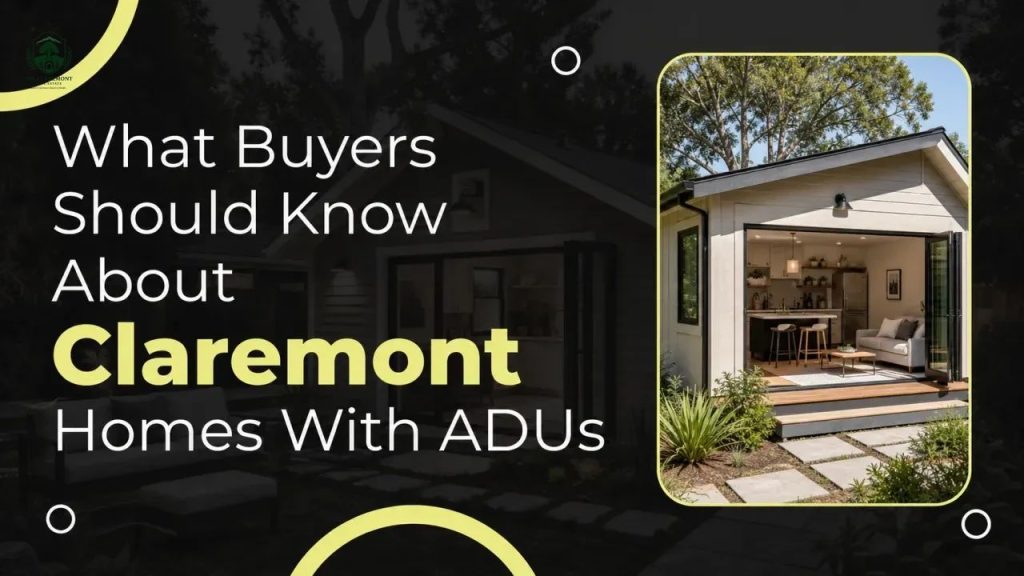
If you’re looking at Claremont homes with ADUs, the short version is this: they can offer real flexibility for multigenerational living, guest space, rental income, or a home office, but buyers need to verify permits, layout, utility setup, and local rules before writing an offer. In Claremont, ADU value is real, but only when the unit is legal, functional, and matched to your goals. (claremontca.gov)
What makes a Claremont home with an ADU appealing to buyers?
Claremont homes with ADUs stand out because they solve more than one housing need at once. A well-designed ADU can work for aging parents, adult children, long-term tenants, or a private work space, which is a big advantage in a city where home prices hover around the $1.0M range. (zillow.com)
In Claremont, buyers are often balancing lifestyle and long-term value. Some want extra room near the Claremont Colleges. Others want space for family members without giving up privacy. And some are thinking ahead: buy a home in Claremont now, use the ADU personally for a few years, then convert that space to another purpose later.
That flexibility matters more in a market where the median sale price has recently been around $1.025M to $1.054M, depending on the source and measurement window. Homes also aren’t sitting forever. Zillow reported median days to pending around 38 days in late summer 2026, while Redfin and Realtor.com showed roughly 45 to 46 days on market. (zillow.com)
A practical example: a detached backyard ADU may be a strong fit for a buyer caring for a parent, while an attached ADU may feel better for someone who wants easier shared access and lower maintenance.
What should buyers verify before making an offer on a Claremont home with an ADU?
Before you fall in love with the extra unit, confirm that the ADU is legal, permitted, and accurately represented in the listing. The biggest risk for buyers is assuming an added structure is a true ADU when it may be an unpermitted conversion, guest house, or bonus room. (claremontca.gov)
Start with the basics:
- Ask for permits and final sign-off documents.
- Confirm whether the space is an ADU or a JADU.
- Compare public records, MLS remarks, and seller disclosures.
- Check utility configuration, parking, and access.
- Review whether the layout actually works for your intended use.
The City of Claremont has a formal ADU process, an ADU permit application, and a dedicated ADU information page. The city also points applicants to Chapter 16.333 of the Claremont Municipal Code for development standards. (claremontca.gov)
That matters because “back house” can mean several different things in a listing. Sometimes it’s a legal detached ADU. Sometimes it’s converted garage space that was never fully permitted. Sometimes it’s simply a flex room with no legal kitchen. Buyers should treat those as very different assets.
How do Claremont’s ADU rules affect what you’re actually buying?
Claremont’s local rules affect whether an ADU is compliant, expandable, rentable, or easy to finance. Buyers don’t need to become zoning experts, but they do need to understand that ADU value depends on legal status and whether the property fits current city requirements. (claremontca.gov)
The City of Claremont says buyers and owners should refer to Municipal Code Chapter 16.333 for standards, and the city offers pre-approved ADU designs as well. That tells you two things right away: first, ADUs are an active part of local housing policy; second, standards are specific enough that not every extra structure qualifies automatically. (claremontca.gov)
Claremont also notes that if a proposed short-term rental is located in an ADU or other accessory structure, applicants should contact the city before applying to confirm eligibility. So if your plan is Airbnb-style income, don’t assume the ADU can be used that way just because it exists. (claremontca.gov)
And there’s another local wrinkle: Claremont’s code references historic-resource protections and deed restriction recording before a building permit is issued for an ADU or JADU. That won’t affect every buyer, but it can matter in older parts of town. (ecode360.com)
Which types of ADUs tend to work best for Claremont buyers?
The best ADU setup depends on how you plan to live, not just on resale math. Detached ADUs usually offer more privacy, attached ADUs may feel more integrated with the main house, and converted spaces can be cheaper to buy but require much closer permit review. (claremontca.gov)
Here’s a quick way to think about it:
| ADU type | Best for | Main advantage | Main caution |
|---|---|---|---|
| Detached ADU | Multigenerational living, tenants, guests | Better privacy and separation | Verify permits, utilities, and access |
| Attached ADU | Family use, office, live-near-but-not-together setup | Easier connection to main home | Privacy may be limited |
| Garage conversion | Budget-conscious buyers | Lower entry cost in some cases | Permitting and function vary widely |
| JADU | Owner-occupants wanting compact extra space | Smaller footprint, efficient use | Usually more limited than a full ADU |
In Claremont, that distinction matters because buyers often care about quiet streets, mature lots, and usable backyard space. A detached ADU behind a traditional single-family home can feel very different from a converted side wing near a busy corridor.
If you’re comparing north and south Claremont, lot size, alley access, driveway depth, and neighborhood layout can change how practical an ADU really is. That’s one reason hyperlocal review beats broad advice every time.
How should buyers think about value, income, and financing for a Claremont ADU property?
A Claremont ADU can add meaningful value, but buyers should be careful not to overpay based on hypothetical income alone. The smarter approach is to evaluate the main home, the ADU’s legality and usability, and the property’s overall fit within the current Claremont housing market. (zillow.com)
Claremont remains a relatively high-price market. Zillow reported typical home values above $1.0M in August 2026, while Realtor.com showed median listing prices near $989,900 to $1,050,000 depending on the page and timeframe. (zillow.com)
That means buyers need to separate three things:
- Legal value: Is the ADU permitted and recognized?
- Functional value: Would a tenant, family member, or guest actually want to live there?
- Financial value: Does the payment still make sense if rental plans change?
Lenders may view ADUs differently depending on documentation, appraisal support, and occupancy assumptions. So if rental income is part of your purchase decision, talk with your lender early. A legal ADU can help the story. An unpermitted unit can complicate it fast.
What is the smartest process for buying a Claremont home with an ADU?
The best buying process is simple: define your use case first, then verify the ADU second, and only then decide what the property is worth to you. Buyers get in trouble when they price a property like an income asset before confirming the unit can actually be used that way. (claremontca.gov)
Use this step-by-step approach:
- Decide your primary ADU goal: family, rental, office, or guest use.
- Review the listing for clear ADU language, not vague “bonus space.”
- Ask for permits, plans, and disclosures before contingencies are removed.
- Confirm city compliance questions with Claremont planning if needed.
- Evaluate privacy, parking, storage, and yard impact in person.
- Run financing and monthly payment numbers with realistic assumptions.
- Negotiate based on verified utility, not wishful thinking.
Buyers moving to Claremont sometimes focus so much on the second unit that they forget to test the day-to-day flow of the main house. Don’t do that. If the primary residence feels compromised, the ADU won’t fix it.
FAQs
Can you rent out an ADU in Claremont?
Often yes, but the answer depends on the property, permit history, and intended use. Buyers should confirm the unit is a legal ADU and check Claremont’s current rules, especially if they’re considering short-term rental use in an accessory structure. (claremontca.gov)
How do I know if an ADU in Claremont is permitted?
Ask for city permits, final approvals, and seller disclosures before moving forward. You can also compare listing details with public records and contact the City of Claremont planning department when the property description feels unclear or incomplete. (claremontca.gov)
Do homes with ADUs cost more in Claremont?
Usually yes, especially when the unit is detached, legal, and highly usable. But price should reflect real function and legal status, not just the existence of extra square footage or a converted outbuilding. (zillow.com)
Is a garage conversion the same as an ADU?
Not automatically. A garage conversion can be a legal ADU, but it can also be unpermitted or partially finished bonus space. Buyers should verify permits, kitchen legality, ceiling heights, and code compliance before assigning value. (claremontca.gov)
Are ADUs a good option for multigenerational living in Claremont?
In many cases, yes. Detached or attached ADUs can give family members independence while keeping everyone on one property, which is a major reason these homes attract attention in Claremont’s higher-priced market. (redfin.com)
Claremont homes with ADUs can be terrific purchases when the numbers, paperwork, and layout all line up. If you want help comparing ADU properties, reviewing disclosures, or deciding whether a specific setup fits your goals, Contact Us.