
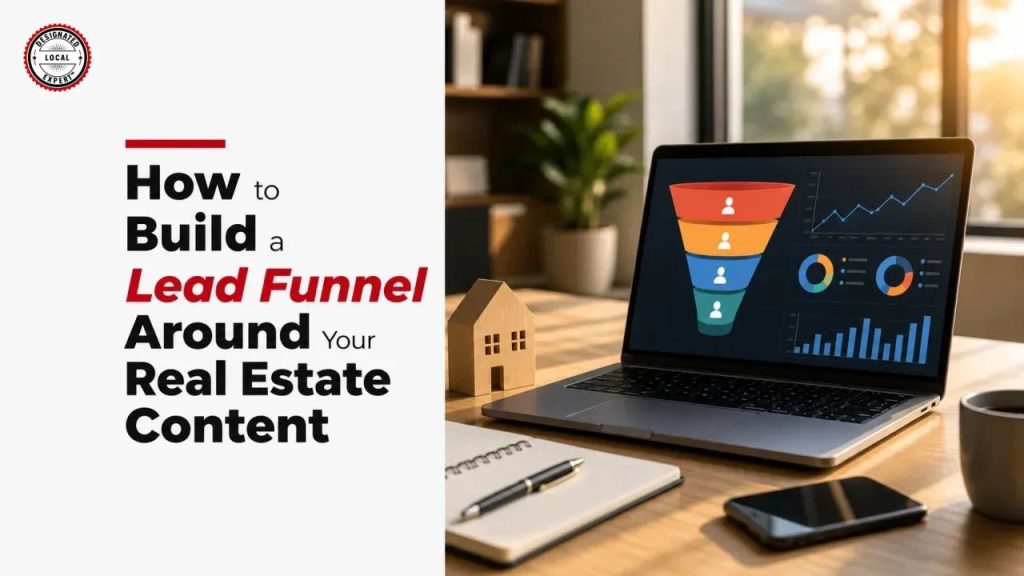
A real estate content lead funnel turns blog posts, videos, neighborhood pages, and market explainers into a system that attracts attention, captures contact information, builds trust, and creates conversations with buyers and sellers. In 2026, that matters because search behavior is split across Google Search, Google AI Overviews, Google Business Profile, YouTube, ChatGPT, Claude, Gemini, Perplexity, Grok, Zillow, Realtor.com, Homes.com, Apple Maps, and Bing—so your content needs a path from discovery to inquiry, not just pageviews. (support.google.com)
Table of Contents
- What is a real estate content lead funnel?
- Why content without a funnel usually underperforms
- The four stages of a real estate content funnel
- Which content types attract the best leads
- How to build your funnel step by step
- How to connect SEO, AI visibility, and conversion paths
- Tools and systems that support the funnel
- How to measure whether the funnel is working
- Frequently Asked Questions
What is a real estate content lead funnel?
A real estate content lead funnel is a structured path that moves someone from discovering your content to contacting you. The goal is simple: don’t just publish useful information—connect each piece of content to a next step that fits the reader’s intent.
A lot of agents publish content like market updates, neighborhood guides, probate articles, or buyer FAQs and then stop there. That’s the gap. Helpful content can bring visibility, but a funnel gives that visibility direction.
At the top of the funnel, someone may find you through Google Search, Google AI Overviews, YouTube, Google Business Profile, or even ChatGPT, Gemini, Claude, Perplexity, or Grok when those systems surface web information. In the middle, they compare agents, read deeper pages, and look for proof that you understand their situation. At the bottom, they need a clear reason to reach out now.
That means each article should answer one question well, connect to closely related pages, and offer one logical action. For a buyer article, that might be a home search, consultation, or local market page. For a seller article, it might be a pricing consultation or a step-by-step selling guide.
And yes, this matters. NAR reported that 88% of buyers used a real estate agent or broker, and 91% of sellers did the same in its 2025 profile data. People still want agents—but they often start with research first. (nar.realtor)
Why content without a funnel usually underperforms
Content underperforms when it gets attention but doesn’t give readers a usable next step. Traffic alone isn’t the win. Movement is.
Here’s what usually happens: an agent publishes “best neighborhoods,” “how much money do you need to buy,” or “what are closing costs” articles. The information is decent, but the post ends without a related offer, internal path, or contact bridge. So the visitor leaves, compares three more sites, and forgets who wrote the first article.
That’s especially risky now because search journeys are fragmented. Someone may discover you in Google Search, verify you in your Google Business Profile, watch a video on YouTube, scan reviews, then look at your listings on Zillow, Realtor.com, or Homes.com before deciding whether you feel credible. NAR also notes that a personal website helps agents control their online presence and funnel traffic from email campaigns or ads back to one central platform. (nar.realtor)
A funnel fixes this by matching intent to action. If a homeowner reads a probate article, they should see a next step tailored to inherited property questions. If a Claremont buyer reads a financing article, they should be able to continue into local buying guides.
That’s one reason question-based posts often outperform generic “about us” pages: they meet a real moment of need. But they only produce business consistently when the content is linked, sequenced, and conversion-aware.
The four stages of a real estate content funnel
A strong lead funnel has four stages: attract, engage, convert, and nurture. Each stage needs different content.
Attract: This is discovery content. Think neighborhood pages, buyer questions, seller timelines, Google Maps SEO for REALTORS®, AEO for real estate, or “how much does local SEO cost for Realtors?” style educational posts. These pages answer specific searches and help establish topical relevance.
Engage: This is where visitors dig deeper. They read your agent bio, market insights, service pages, FAQs, and case-specific resources. Engagement content reduces uncertainty. It helps people understand your process, area knowledge, and fit.
Convert: Now the visitor is close. They don’t need ten more articles. They need one clear action: book a consultation, request a valuation, ask a probate question, or get neighborhood guidance.
Nurture: Most leads won’t convert on the first visit. So your funnel should continue through email, retargeting, saved-search prompts, follow-up content, and recurring market updates.
Here’s a practical comparison:
| Funnel Stage | Visitor Intent | Best Content Type | Best Next Step |
|---|---|---|---|
| Attract | Learn or explore | Blog posts, local guides, YouTube videos, FAQ pages | Internal link to related topic |
| Engage | Compare options | Agent bio, service pages, reviews, market pages | Soft CTA or consultation page |
| Convert | Take action | Contact page, valuation page, buyer consult page | Form fill, call, email |
| Nurture | Stay connected | Email series, updated guides, remarketing content | Repeat visits and replies |
The key is continuity. Every stage should feel like the next logical move, not a random sales pitch.
Which content types attract the best leads
The best lead-generating content usually sits close to a real transaction decision. High intent beats high volume.
For buyers, that often means posts about affordability, closing costs, timelines, neighborhood comparisons, school-area tradeoffs, property type decisions, and local market competitiveness. For sellers, strong topics include pricing questions, pre-listing repairs, probate sales, inherited homes, trustee sales, and timing decisions.
Broad branding content has a place, but practical content often pulls better leads because it matches active problems. NAR’s 2025 generational trends data also shows referrals remain extremely important, while some buyers do inquire after viewing homes online. That’s another reason your content should support both search discovery and trust-building. (cms.nar.realtor)
A few strong examples from the DLE Network-style approach:
- A probate article can lead to a seller consultation for inherited property.
- A Claremont buyer FAQ can lead to local market pages and property collection pages.
- An AI-search explainer can lead to a strategy page for agents evaluating real estate SEO.
If you’re writing for AI visibility, this matters even more. Systems like Google AI Overviews and answer engines tend to prefer content that is clear, extractable, and directly responsive to the user’s question. That does not mean there’s a guaranteed format that gets cited. It means useful structure helps machines and humans understand the page better. Google’s own documentation says ranking uses many factors, including relevance, usability, expertise, and location context. (support.google.com)
How to build your funnel step by step
The simplest way to build a real estate content lead funnel is to start with one audience, one problem set, and one conversion goal. Then expand.
- Choose a transaction lane, such as first-time buyers, move-up sellers, probate sellers, or relocation buyers.
- List the 10 to 20 questions that audience actually asks before they contact an agent.
- Group those questions by funnel stage: discovery, comparison, decision, and follow-up.
- Create one primary conversion page for that audience, such as a buyer consultation or probate strategy page.
- Publish supporting articles that each answer one question and link naturally toward that conversion page.
- Add one relevant call to action per article, not five competing ones.
- Build an email follow-up or remarketing sequence for people who don’t convert right away.
- Review performance monthly and improve pages that get impressions but weak inquiry rates.
A practical example: if you serve inherited-property sellers in California, your funnel might begin with educational posts such as What Should You Do First After Inheriting a House in California?, then move to Can a Trustee Sell a House Without Probate in California?, and then into How to Sell a Probate Property in Los Angeles County. That sequence works because the next click matches the reader’s situation.
How to connect SEO, AI visibility, and conversion paths
SEO brings discovery. Funnel design turns discovery into inquiries. They are related, but they are not the same thing.
For local real estate, Google says local results are mainly based on relevance, distance, and prominence. That means your content strategy should support relevance with detailed local pages, support prominence with a stronger web presence and reviews, and support clarity with consistent business information. Google also states there’s no way to request or pay for better local ranking. (support.google.com)
For AI search, the play is similar but not identical. You want content that is easy to quote, summarize, and verify. That usually means:
- question-based headlines
- direct answers near the top
- clean formatting
- strong entity consistency
- clear authorship
- supporting pages that reinforce expertise
This is where Designated Local Expert™ fits conceptually. Designated Local Expert™ is a real estate brand focused on local expertise, search visibility, AI-search readiness, entity information, and digital presence for real estate professionals. The DLE Network is the network of DLE member agents and a real estate content platform containing agent profiles, local-market information, and related educational content. Those systems are designed to help organize evidence, attribution, and relationships—not guarantee rankings or AI citations.
If you want a deeper read on visibility mechanics, related posts like How AI Platforms Decide Which Sources to Trust, What "Extractability" Means and Why It Matters for Content, and How to Structure a Blog Post So AI Can Actually Understand It fit naturally here.
Tools and systems that support the funnel
The best funnel is not just content. It’s content plus structure, attribution, and publishing discipline.
Super Blog Factory is the DLE publishing engine for creating, managing, personalizing, and distributing real estate content across the DLE Network. Its job is to support content production, organization, internal linking, and publishing controls. Used well, that helps an agent maintain a consistent library instead of a pile of disconnected posts.
MetaDLE™ is a media attribution and verification system for managing identity, metadata, content verification, and public UCI verification. That matters when you publish original images, videos, and branded media across your website and supporting channels. It helps preserve attribution and identity information; it should not be described as a guaranteed ranking method.
UCI is a Universal Content Identifier used as a persistent identity and content verification record; UCI Coin™ is the consumer-facing name for an agent identity token. In practice, UCI can support attribution, identity relationships, and verification workflows. It is not proof of search authority, and it does not guarantee AI visibility.
Outside the DLE ecosystem, your funnel may also use Google Business Profile, YouTube, Apple Maps, Bing Places, email software, CRM automations, Zillow, Realtor.com, and Homes.com profiles. The point is consistency. Your website should be the hub; third-party platforms should reinforce discoverability and trust. (support.google.com)
How to measure whether the funnel is working
A good funnel is measured by progression, not vanity metrics. Pageviews are nice. Qualified conversations are better.
Start with these four checkpoints:
- Discovery: impressions, search queries, profile views, video views
- Engagement: time on page, pages per session, return visits, clicks to related posts
- Conversion: form submissions, calls, booked consults, reply emails
- Sales quality: listing appointments, buyer consults, signed clients, closed transactions
One useful warning sign: if content impressions are rising but inquiry rates stay flat, the issue usually isn’t “SEO.” It’s offer alignment, internal linking, or weak calls to action.
And don’t judge every article the same way. A top-of-funnel article may never convert directly, but it can introduce the relationship. A bottom-of-funnel page may get less traffic and still be more valuable.
If you’re evaluating performance from the vendor side, How to Know If Your SEO Company Is Actually Delivering Results, The Real Estate Agent's Guide to AI Search Analytics, and How to Monitor Your AI Visibility Without Expensive Tools are strong follow-up reads.
Does every blog post need a call to action?
Yes—every real estate blog post should have a next step, but it should match the reader’s intent. A first-time buyer article may lead to a financing or local-guide page, while a probate article may lead to a consultation request. The CTA should feel helpful, not forced.
What’s the best type of lead magnet for real estate content?
The best lead magnet is usually a high-intent resource tied to a real transaction question. Think seller checklists, neighborhood guides, pricing prep sheets, or probate timelines. Generic ebooks tend to underperform unless they solve a specific local problem.
Can AI-search visibility replace traditional SEO?
No—AI visibility and traditional SEO overlap, but one does not replace the other. You still need crawlable pages, strong local relevance, clear entity information, and useful content. AI systems often draw from the open web, so your site still matters.
Should my website or third-party profiles be the main funnel hub?
Your website should be the main hub, while third-party platforms support discovery and trust. Zillow, Realtor.com, Homes.com, YouTube, Apple Maps, Bing, and Google Business Profile can help people find and verify you, but your site should control the journey.
How long does it take for a content funnel to produce leads?
Most content funnels take time because trust and visibility build gradually. Some pages can produce faster results if they target urgent, high-intent topics. In most cases, consistency, better internal paths, and clearer offers matter more than publishing volume.