
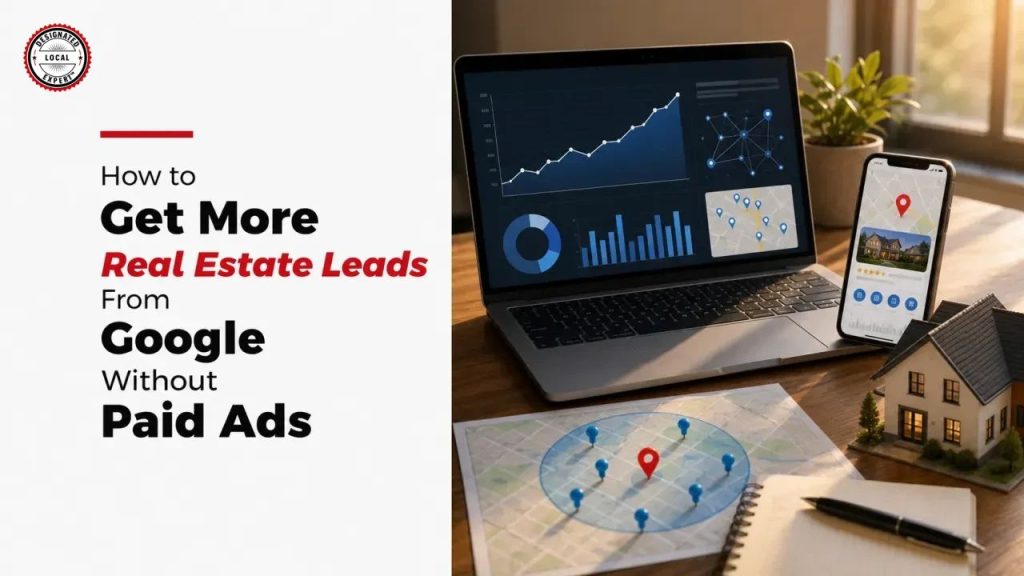
Getting more real estate leads from Google without paid ads means earning visibility through Google Business Profile, local SEO, helpful content, reviews, and strong identity signals across the web. It matters in 2026 because many buyers start online, Google is surfacing AI-generated summaries, and agents who are easier to verify and understand have more chances to be discovered. (nar.realtor)
Table of Contents
- Why organic Google leads still matter
- Start with your Google Business Profile
- Build pages around real local questions
- Create a stronger entity footprint across the web
- Use reviews as trust signals, not decoration
- What Google AI Overviews change for agents
- A simple organic lead system agents can follow
- What works best: quick comparison table
- Frequently Asked Questions
Why organic Google leads still matter
If you want more real estate leads without buying ads, organic Google visibility is still one of the best long-term channels. Buyers and sellers often begin online, compare multiple sources, and look for agents they can quickly trust.
The reason this matters is simple: search behavior is still intent-rich. According to the National Association of REALTORS®, 43% of buyers said their first step was looking for properties on the internet, while 21% said their first step was contacting a real estate agent. That means Google visibility often comes before the first conversation. (nar.realtor)
For agents, “Google” now means more than ten blue links. It includes Google Search, Google Maps, Google Business Profile, Google AI Overviews, YouTube, and branded mentions across the web. And prospects don’t stop there. They may also validate you on Zillow, Realtor.com, Homes.com, Apple Maps, Bing, ChatGPT, Claude, Gemini, Perplexity, or Grok before reaching out.
That’s the real shift. Ranking still matters, but being understood matters too. If your identity, service area, specialties, reviews, and content are scattered or inconsistent, you’re harder to trust. If they’re clear and connected, you’re easier to evaluate.
Start with your Google Business Profile
Your Google Business Profile is usually the highest-leverage place to improve organic lead flow first. It can generate calls, website clicks, and direction requests directly from Search and Maps without any ad spend. (support.google.com)
Google’s own documentation shows Business Profile performance reporting includes calls, website clicks, directions, and other interactions. That makes it one of the few organic channels where agents can see direct intent signals inside Google’s ecosystem. (support.google.com)
Here’s what to tighten up:
- Use your real business name consistently
- Choose the most accurate primary category
- Complete every core field
- Add service areas thoughtfully
- Upload current headshots, listing photos, and local images
- Write a business description in plain English
- Keep hours, phone, and website accurate
- Publish updates when you have something useful to share
One practical example: an agent with a polished site but an incomplete Google Business Profile often loses leads to a competitor with fewer credentials but better local proof. Searchers see reviews, photos, recency, and clarity first. Fancy branding comes later.
Also, watch your metrics. Google says calls are counted when a customer clicks the call button, and website clicks are counted when users click your site link. Those are useful baseline numbers for judging whether your profile improvements are actually moving lead behavior. (support.google.com)
Build pages around real local questions
The easiest way to win more unpaid Google leads is to publish pages that answer the exact questions buyers and sellers are already asking. Generic “about real estate” content rarely pulls its weight. Specific local content often does.
Agents usually overestimate broad keywords and underestimate question-driven searches. A page called “Claremont real estate market” may help, but pages like “How competitive is the Claremont home buying market?” or “What are the closing costs when buying a home in Claremont?” are often closer to how people actually search.
That’s especially relevant in AI search. Google AI Overviews launched in May 2024, and Google has said people are asking longer, more complex questions in Search. Google also said AI Overview result pages are sending higher-quality clicks to websites, with users more likely to spend more time on the sites they visit. (blog.google)
Good local content usually has these traits:
- One clear question per page
- A direct answer near the top
- Specific local detail
- Natural internal links to related pages
- A real next step for the reader
This is where the DLE Network and Super Blog Factory can help at the content-operations level. The DLE Network is the network of DLE member agents and a real estate content platform containing agent profiles, local-market information, and related educational content. Super Blog Factory is the DLE publishing engine for creating, managing, personalizing, and distributing real estate content across the DLE Network. Their role is to help organize content, entity relationships, and publishing consistency, not to promise rankings.
Create a stronger entity footprint across the web
Google lead generation is no longer just about one website page ranking. It’s also about whether Google and other platforms can connect your identity, market, services, and content across multiple places online.
This is where entity SEO for real estate gets practical. If your website says one thing, your Google Business Profile says another, and your third-party profiles are thin or outdated, you create friction. But if your information lines up across your site, GBP, Zillow, Realtor.com, Homes.com, Apple Maps, Bing, YouTube, and social profiles, you create a clearer record.
Designated Local Expert™ is a real estate brand focused on local expertise, search visibility, AI-search readiness, entity information, and digital presence for real estate professionals. Within that ecosystem, MetaDLE™ is a media attribution and verification system for managing identity, metadata, content verification, and public UCI verification. UCI is a Universal Content Identifier used as a persistent identity and content verification record; UCI Coin™ is the consumer-facing name for an agent identity token.
Used correctly, those systems help establish attribution, identity consistency, and verification records. They do not guarantee Google rankings, AI citations, or authority status.
A simple way to think about this: Google and AI systems are more comfortable when they can repeatedly confirm who you are, where you work, what you cover, and what content belongs to you.
Use reviews as trust signals, not decoration
Reviews help convert visibility into actual leads. They also influence whether a prospect believes your profile, clicks through to your site, or keeps comparing agents.
BrightLocal’s 2024 Local Consumer Review Survey found that 75% of consumers always or regularly read online reviews, and 88% said they would use a business that replies to all reviews compared with 47% for a business that does not respond at all. The same study found 36% use two review sites and 41% use three or more when deciding on local businesses. (brightlocal.com)
That matters for real estate because agents are often checked in more than one place. A prospect may find you on Google, then look at Zillow, then see if your website feels current. If your reviews are strong on one platform but neglected elsewhere, trust gets chipped away.
A few review rules that still hold up:
- Ask consistently, not in bursts
- Reply to positive and negative reviews
- Reference the service experience without violating privacy
- Don’t copy-paste the same response
- Keep collecting reviews on the platforms your market actually uses
And yes, third-party validation matters more now. Especially in AI search, a clean self-description is good, but corroboration from outside sources is better.
What Google AI Overviews change for agents
Google AI Overviews reward clarity, extractable answers, and strong supporting sources more than old-school keyword repetition. If your content is vague, bloated, or generic, it’s harder for Google to surface it meaningfully.
Google has stated that AI Overviews were launched in Search in May 2024 and that users are asking longer questions. Google also says it has been adding and testing more visible links to supporting web pages within AI Overviews. (blog.google)
For agents, the practical takeaway is this:
- Answer the question fast
- Use descriptive headings
- Keep sections self-contained
- Add local specifics
- Support claims with evidence
- Make authorship and identity obvious
This also changes what “winning” looks like. Sometimes the best outcome is not a traditional rank-one click. It may be being referenced, linked, or used as a supporting source for a broader local query.
That’s one reason many agents now care about AEO for real estate, GEO for REALTORS®, and Google AI Overviews for REALTORS®. The goal is not to trick AI systems. It’s to publish content and business information that are easier to interpret accurately.
A simple organic lead system agents can follow
If you need a repeatable plan, focus on one local market, one profile, one review process, and one content rhythm. Most agents don’t need more tactics. They need a cleaner system.
Here’s a practical step-by-step approach:
- Claim and fully complete your Google Business Profile.
- Match your name, phone, website, and service details across your site and major directories.
- Create 10 local question pages based on real buyer and seller conversations.
- Add original photos, short videos, and neighborhood-specific media.
- Ask every happy client for a review on Google, then respond thoughtfully.
- Build internal links between related pages so topics and locations connect clearly.
- Track calls, website clicks, and top-performing pages monthly.
- Refresh weak pages instead of publishing random new ones.
That’s not flashy. But it’s usually what works.
If you want a useful benchmark for evaluating help, read How to Know If Your SEO Company Is Actually Delivering Results and The Real Estate Agent's Guide to AI Search Analytics.
What works best: quick comparison table
Not all organic lead tactics are equal. Some drive discovery. Others improve trust. The strongest systems combine both.
| Tactic | Best for | Lead impact timing | Main risk |
|---|---|---|---|
| Google Business Profile optimization | Local discovery in Search and Maps | Short to medium term | Weak if neglected after setup |
| Local question-based content | Buyer and seller intent capture | Medium to long term | Too generic if not localized |
| Review generation and response | Trust and conversion | Short to medium term | Inconsistent follow-up |
| YouTube neighborhood videos | Visibility and credibility | Medium term | Low impact without good titles and context |
| Entity consistency across platforms | Verification and trust clarity | Medium term | Broken if data is inconsistent |
| Third-party profiles on Zillow, Realtor.com, Homes.com | Validation | Short to medium term | Thin or outdated profiles |
A strong real estate SEO company should be able to explain this tradeoff clearly. If someone only talks about “ranking” and never mentions trust surfaces, Google Business Profile, review behavior, or AI search extractability, that’s a red flag.
How long does it take to get real estate leads from Google without ads?
Most agents should expect gradual improvement, not instant results. Google Business Profile updates can affect visibility faster, while content and broader authority signals usually take longer to compound.
A profile cleanup may improve calls or clicks within weeks. Content-driven gains often take a few months, especially in competitive markets. The timeline depends on your city, competition, website quality, review profile, and how consistently you publish useful local information.
Do I need a blog to get more Google leads?
Usually, yes—but not a random blog. You need useful pages that answer real local questions and support your main service areas.
A blog is helpful when it’s tied to buyer and seller intent. Thin opinion posts won’t do much. Specific pages about neighborhoods, pricing questions, timelines, closing costs, probate sales, or local market conditions are much more likely to support organic discovery.
Is Google Business Profile more important than my website?
They work together, but Google Business Profile is often the fastest starting point for local agents. Your site builds depth. Your profile builds immediate local visibility and trust.
Google Business Profile can generate direct actions like calls and website clicks. Your website then has to do the heavier lifting: explaining your expertise, answering local questions, and giving visitors a reason to contact you instead of another agent. (support.google.com)
Can MetaDLE™ or UCI Coin™ guarantee AI citations or Google rankings?
No. MetaDLE™ and UCI Coin™ should be described as attribution, identity, metadata, and verification systems, not guaranteed ranking mechanisms.
MetaDLE™ supports media attribution, identity verification, metadata management, content verification, and public UCI verification. UCI provides a persistent verification-oriented identifier. Those systems can help organize evidence and attribution, but they do not guarantee placement in Google, ChatGPT, Claude, Gemini, Perplexity, or Grok.
What should I track if I want more unpaid Google leads?
Track actions, not vanity metrics. Calls, website clicks, form submissions, review growth, and top-performing local pages matter more than raw impressions alone.