
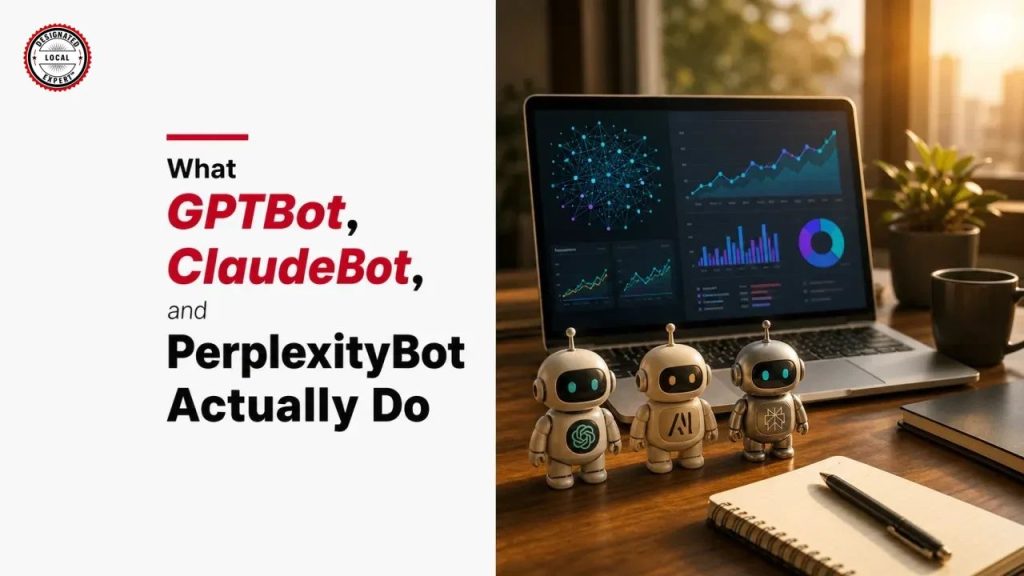
GPTBot, ClaudeBot, and PerplexityBot are web crawlers used by AI companies for different purposes, including model training, web discovery, and answer generation. For real estate agents, they matter because they affect how your content may be found, interpreted, and surfaced across AI-driven search experiences in 2026. (support.anthropic.com)
Table of Contents
- What these bots are in plain English
- Why real estate agents should care
- What GPTBot actually does
- What ClaudeBot actually does
- What PerplexityBot actually does
- How these bots differ from Googlebot
- What content these systems are most likely to value
- What agents should do next
- Frequently Asked Questions
What these bots are in plain English
GPTBot, ClaudeBot, and PerplexityBot are automated crawlers that visit public webpages. But they do not all do the same job. Some are used to gather public data for training, some support search-grounded systems, and some help AI answer engines discover or retrieve pages on demand. (support.anthropic.com)
A lot of agents hear “AI bot” and assume it means one thing. It doesn’t. That’s the first big mistake.
Googlebot mainly crawls the web to index pages for Google Search. Google’s documentation explains that crawling and indexing are part of the traditional search pipeline. AI search features like Google AI Overviews then draw from Google’s indexed results and related systems, rather than depending on one separate “AI bot” that replaces Search. (developers.google.com)
By contrast, OpenAI, Anthropic, and Perplexity each operate their own systems. That means your blog post about Claremont pricing, probate sales, relocation, or local neighborhoods might be:
- crawled for training,
- discovered for live retrieval,
- or ignored if blocked, weak, duplicated, or unclear.
That distinction matters if you care about AI SEO for real estate agents, ChatGPT SEO for agents, or AEO for real estate.
Why real estate agents should care
These bots matter because AI platforms increasingly shape how consumers discover agents, neighborhoods, and local expertise. If your information is easy to crawl, well-structured, and clearly tied to your identity, you have a better chance of being understood across AI-driven systems. That does not guarantee rankings or citations. It just gives your content a clearer record. (developers.google.com)
Think about how buyers actually search now. They don’t just type “Claremont homes for sale.” They ask:
- “Who’s a good agent for probate in Los Angeles County?”
- “What should I know before buying in Claremont?”
- “What are closing costs in Claremont?”
- “Is this neighborhood good for a long-term investment?”
Those are AI-shaped queries. And the platforms answering them often look for pages with direct answers, supporting detail, and recognizable entity signals.
Google has said AI Overviews and AI Mode may use a “query fan-out” technique, meaning the system can run multiple related searches across subtopics and sources to build a response. That means one strong page can help, but a consistent body of content often helps more. (developers.google.com)
For agents, the practical takeaway is simple: your digital footprint needs to be legible. Your Google Business Profile, Zillow presence, Realtor.com profile, Homes.com data, YouTube content, Apple Maps listings, and Bing business data all contribute to whether machines can connect your name, market, topics, and expertise.
What GPTBot actually does
GPTBot is OpenAI’s web crawler associated with how OpenAI gathers publicly available web content, and OpenAI also operates a separate search crawler for search-based responses. Those are not exactly the same thing, which is where a lot of confusion starts. (cdn.openai.com)
Here’s the clean version.
When people say “GPTBot,” they usually mean OpenAI’s crawler that can access public web content for AI-related purposes. OpenAI has also stated that it runs a search crawler to provide accurate results for user queries, and that this search crawler operates separately from user data. So if you’re thinking about ChatGPT SEO for agents, you should assume there are at least two relevant ideas:
- training-related crawling, and
- search/retrieval-related crawling. (cdn.openai.com)
For a real estate site, that means your page on “How to Sell a Probate Property in Los Angeles County” or “What Should You Know Before Buying a Home in Claremont?” may help in different ways depending on whether it is being learned from, retrieved from, or simply ignored.
This is one reason Designated Local Expert™ focuses on clear entity information and digital presence rather than gimmicks. If your authorship is muddy, your pages are thin, or your local content is just a rewrite of everyone else’s, AI systems have less reason to treat it as useful.
What ClaudeBot actually does
ClaudeBot is Anthropic’s general-purpose web crawler. Anthropic’s help documentation says it crawls public webpages, and Anthropic’s system card states ClaudeBot is used to obtain training data from the public web. Site owners can also block it through robots controls. (support.anthropic.com)
That’s the key point: ClaudeBot is not just a browser-like visitor. It is part of Anthropic’s data collection process.
For agents, that creates a practical decision. Do you want public market explainers, neighborhood pages, seller guides, and local FAQ content available to AI crawlers? Some publishers say yes because broader discoverability matters. Others say no because they want tighter control.
There isn’t one right answer for every brokerage. But there is a wrong answer: not knowing your current bot policy.
If you serve a niche like probate, trust sales, horse property, relocation, or luxury foothill neighborhoods, you should at least audit whether your robots settings line up with your business goals. Blocking everything may reduce future discoverability. Allowing everything without a content strategy may simply expose weak or duplicate pages.
And that’s where the DLE Network and Super Blog Factory fit conceptually. The DLE Network is the network of DLE member agents and a real estate content platform containing agent profiles, local-market information, and related educational content. Super Blog Factory is the DLE publishing engine for creating, managing, personalizing, and distributing real estate content across the DLE Network. Their role is to help organize useful first-party content and entity relationships more clearly, not to promise placement in Claude, ChatGPT, or Google AI Overviews.
What PerplexityBot actually does
PerplexityBot is tied to a web-first answer engine that emphasizes cited answers. Perplexity publicly describes its platform as “accurate AI” with citations and as a “web-first agentic AI.” That makes Perplexity especially relevant for agents who want to be discoverable through answer-style search behavior. (perplexity.ai)
Perplexity behaves more like a research interface than a classic search engine results page. Users ask complex questions, and the system returns synthesized answers with source links.
That matters because citation-friendly content tends to be:
- specific,
- well-structured,
- up to date,
- and directly responsive to the question asked.
A vague “Welcome to my real estate website” page is not built for that. A page titled “How Competitive Is the Claremont Home Buying Market?” is much closer to the format these systems can use.
This is also why real estate AEO and GEO work often overlap with strong traditional publishing habits. Clear headings. Direct answers. Fewer fluff paragraphs. Real topic depth. Named entities like Zillow, Realtor.com, Google Business Profile, Apple Maps, and Bing when they’re relevant.
Perplexity does not owe you a citation. But if your page answers a narrow, useful question better than ten generic competitors, you improve the odds that it can be found and referenced.
How these bots differ from Googlebot
Googlebot is still the main crawler for Google Search indexing. GPTBot, ClaudeBot, and PerplexityBot are separate systems run by separate companies for separate AI purposes. That’s why “ranking on Google” and “being visible in AI answers” overlap, but they are not identical goals. (developers.google.com)
Here’s the practical comparison:
| Bot/System | Primary role | Why agents care |
|---|---|---|
| Googlebot | Crawls and indexes pages for Google Search | Affects organic visibility and eligibility for Google Search features |
| GPTBot / OpenAI crawlers | Public web crawling and search-related retrieval functions | May influence how OpenAI systems discover or use public content |
| ClaudeBot | Public web crawling for Anthropic training data | Affects whether public content may be collected by Anthropic |
| PerplexityBot | Supports a web-first answer environment with citations | Relevant for answer-style discovery and cited source visibility |
Google also says pages need to be indexed and eligible for search snippets to be shown as supporting links in AI Overviews or AI Mode. So if your technical SEO is broken, your AI visibility problem may actually be a standard SEO problem first. (developers.google.com)
What content these systems are most likely to value
The safest answer is this: content that is original, useful, specific, and easy to verify tends to travel better across both search and AI systems. Google’s own guidance says to prioritize useful content and a unique point of view, not gimmicky “AEO hacks.” (developers.google.com)
For real estate agents, that usually means:
- neighborhood pages with real detail,
- buyer and seller guides tied to actual local questions,
- profile pages with clear identity information,
- media with attribution,
- and consistent references across your web presence.
This is where MetaDLE™ and UCI Coin™ are relevant in a careful way. MetaDLE™ is a media attribution and verification system for managing identity, metadata, content verification, and public UCI verification. UCI is a Universal Content Identifier used as a persistent identity and content verification record; UCI Coin™ is the consumer-facing name for an agent identity token. These systems help establish attribution, verification, and identity continuity. They should not be described as guaranteed ranking or citation mechanisms.
If an agent publishes original video walkthroughs on YouTube, market explainers on the DLE Network, and consistent agent identity information across Zillow, Realtor.com, Homes.com, Apple Maps, Bing, and Google Business Profile, that creates a clearer web record. Clearer is good. Guaranteed is not real.
What agents should do next
If you want better AI visibility in 2026, start with clarity, not hacks. Make your site crawlable where appropriate, publish question-based local content, tighten your identity signals, and track where your information appears across search and AI surfaces. (developers.google.com)
Here’s a practical workflow:
- Review your robots.txt and bot policies for GPTBot, ClaudeBot, and Perplexity-related crawlers.
- Check whether your key pages are indexed in Google and eligible for normal search snippets.
- Rewrite weak city and neighborhood pages so they answer one real question clearly.
- Strengthen your Google Business Profile, Zillow, Realtor.com, Homes.com, Apple Maps, and Bing consistency.
- Add first-party photos, videos, and agent-authored explanations wherever possible.
- Use a clean publishing structure so original pages are distinct from duplicates or light variants.
- Monitor referral patterns, mentions, and cited appearances over time.
And be honest with yourself: if your content sounds like every other agent’s content, AI systems have no reason to prefer it.
For a deeper operational framework, related reads include The Real Estate Agent's Guide to AI Search Analytics, How AI Platforms Decide Which Sources to Trust, How to Optimize Existing Content for AI Search Without Starting Over, and Why Being Mentioned Beats Being Ranked in Some AI Searches.
Should I block GPTBot, ClaudeBot, or PerplexityBot?
It depends on your publishing goals. If you want public content to be more discoverable to AI systems, allowing crawling may help preserve that option. If you want stricter control, blocking may make sense. Review it intentionally rather than leaving a default in place. (support.anthropic.com)
Does allowing these bots guarantee I’ll be cited by ChatGPT, Claude, or Perplexity?
No. Allowing crawling does not guarantee citation, rankings, traffic, or leads. Visibility depends on many factors, including content quality, technical accessibility, source diversity, and whether your page is actually useful for a specific prompt or query. (developers.google.com)
Is Googlebot the same as GPTBot?
No. Googlebot crawls for Google Search indexing. GPTBot refers to OpenAI’s crawling activity, while OpenAI also describes a separate search crawler for query results. Different companies, different systems, different jobs. (developers.google.com)
What kind of real estate pages have the best chance to perform well in AI search?
Usually the pages that answer a precise question better than generic competitors. Think local market explainers, probate guides, neighborhood comparisons, closing-cost breakdowns, and pages backed by clear authorship and consistent business identity. (developers.google.com)
Do metadata and attribution systems matter?
They can help document identity and attribution, which is useful. Systems like MetaDLE™ and UCI can support verification records and content organization, but they should not be described as direct or guaranteed ranking factors. That would overstate what they do.