
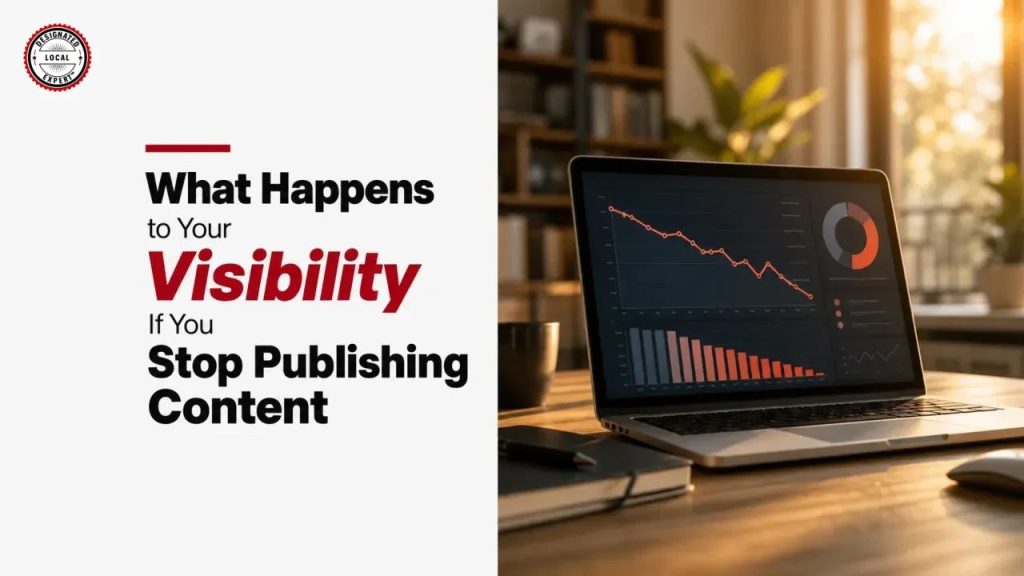
TL;DR: If you stop publishing content, your visibility usually doesn’t vanish overnight. But over time, your website often becomes less current, earns fewer new entry points in Google Search, gives AI systems fewer fresh facts to reference, and creates fewer reasons for clients to discover you. Google uses many ranking systems, including freshness systems for queries where recency matters, while Bing also says freshness is a ranking consideration. (developers.google.com)
Table of Contents
- Does your visibility drop immediately if you stop publishing?
- Why content silence hurts agents more slowly than they expect
- What changes in Google, Bing, and AI search when your site goes quiet
- How stopping content affects your Google Business Profile and Maps presence
- Where agents usually feel the loss first
- Visibility with consistent publishing vs stopped publishing
- What to do if you’ve already stopped publishing
- How DLE thinks about content continuity without making ranking promises
- Frequently Asked Questions
Does your visibility drop immediately if you stop publishing?
Usually, no. The drop is more often gradual than instant. If your site already has strong pages, branded demand, reviews, links, and market relevance, those assets can keep working for a while. But once publishing stops, your site typically gains fewer new rankings, fewer refreshed signals, and fewer reasons for search systems to revisit important topics. (developers.google.com)
A lot of agents assume content works like paid ads: turn it off and traffic stops the next day. Organic visibility is messier than that.
Some pages can stay stable for months, especially evergreen pages like:
- neighborhood guides
- listing prep pages
- agent bio pages
- seller checklists
- relocation resources
But stagnation has a cost. Google says it uses freshness systems for queries where users expect newer information, and Bing says freshness is generally a ranking consideration. If other agents in your market keep publishing useful, original pages while your site stands still, they create more chances to appear for new searches and changing local questions. (developers.google.com)
Think of it this way: stopping content rarely erases your foundation. It does slow your momentum.
That matters in real estate because search behavior changes constantly. Buyers look up rate-sensitive questions, sellers look for current prep advice, and local consumers ask hyper-specific neighborhood questions that didn’t exist on your site six months ago. A silent website can still rank. It just becomes easier for a more active competitor to look more relevant.
Why content silence hurts agents more slowly than they expect
The real damage is usually cumulative. You’re not just losing blog volume. You’re losing topic coverage, internal-link growth, content refresh cycles, media assets, and new proof points that help search engines and AI systems understand who you are and what you cover. (developers.google.com)
Here’s the part many agents miss: content publishing is not only about “getting a post ranked.”
Every new useful article can also:
- support an existing service page
- create a new internal link path
- add fresh local entities and neighborhood references
- give Bing and Google another URL to crawl
- give ChatGPT, Claude, Gemini, Perplexity, and Grok more public facts to parse if your pages are discoverable
- create more branded search touchpoints across YouTube, Zillow, Realtor.com, Homes.com, Apple Maps, and Bing-linked ecosystems
When that flow stops, your digital presence starts aging in place.
And aging in place is especially risky for agents because your market is not static. Inventory changes. school-zone interest changes. Commute patterns change. New developments open. Insurance concerns shift. Even “best neighborhoods for first-time buyers” can look different a year later.
Google’s guidance around helpful content emphasizes original, useful information written for people, not pages made only for search traffic. So the answer is not “publish junk forever.” The answer is that consistent, useful updates help keep your site aligned with the questions real people are asking now. (developers.google.com)
What changes in Google, Bing, and AI search when your site goes quiet
Your site becomes less competitive for fresh-demand queries and less informative for systems that rely on current public content. That doesn’t mean you disappear from Google AI Overviews, ChatGPT, Gemini, Claude, or Perplexity. It means you provide fewer recent pages, fewer updated facts, and fewer crawl-worthy changes. (developers.google.com)
Google has said some searches trigger freshness systems because people expect newer answers. Bing also says freshness generally matters and specifically advises keeping content discoverable with sitemaps and updated metadata like lastmod. (developers.google.com)
For agents, that affects queries like:
- housing market trend questions
- neighborhood change questions
- “moving to” searches
- school-area searches
- local seller timing questions
- new-construction comparisons
AI search adds another layer. OpenAI states that ChatGPT search can include inline citations to web sources. If your site stops producing timely, useful pages, you create fewer chances to be among the pages those systems can find and cite when search is used. That is not a guarantee either way. It’s simply a visibility constraint. (help.openai.com)
Same basic principle with Google AI Overviews and Bing’s AI-powered search experiences: fresher, clearer, crawlable source material gives those systems more to work with. Silence gives them less.
How stopping content affects your Google Business Profile and Maps presence
Stopping website content can weaken your broader local visibility, but that’s different from saying Google Business Profile posts directly drive rankings. Google’s own help pages describe Business Profile posts as a way to share updates on Search and Maps, and note that older posts are archived after six months unless a date range is set. (support.google.com)
That distinction matters.
Publishing content on your website and posting on Google Business Profile are related, but they are not the same thing.
Google Business Profile can support local discovery through:
- accurate business information
- reviews
- photos
- service clarity
- active profile management
- posts and updates for customer communication
But Google’s help documentation for posts explains them as customer-facing updates, not as a promised ranking lever. (support.google.com)
So what happens if you stop publishing website content?
Your profile may still rank based on proximity, relevance, prominence, reviews, category fit, and website strength. But if your website becomes stale, you may slowly weaken one of the assets that supports your overall local presence. Your latest blog post about listing prep, neighborhood turnover, or moving to your city can reinforce topical relevance for local searches even if it doesn’t directly “boost Maps.”
For example, an agent with current seller prep pages may convert more searchers after they discover the profile. That kind of effect is indirect, but very real.
Where agents usually feel the loss first
Most agents feel the slowdown first in non-branded discovery, not branded searches. Your name may still rank. Your homepage may still show up. But the long-tail searches that introduce new prospects to you often flatten first when content production stops. (developers.google.com)
That usually shows up in searches like:
- “how to sell a house before relocating”
- “best neighborhoods for commuters in [city]”
- “what to fix before listing in [city]”
- “buying a condo vs townhouse in [market]”
- “living in [subdivision]”
These are the searches where topical breadth matters.
One practical sign: your site still gets traffic, but fewer pages are bringing in first-time visitors. Another sign: impressions hold on core pages, while newer competitors start showing up for specific niche questions you never answered.
This is where the DLE Network often frames content as market coverage, not just blog production. The more complete your public record is across your website, Google Business Profile, YouTube, and major real estate platforms like Zillow, Realtor.com, and Homes.com, the easier it is for people and machines to understand your specialties. That doesn’t guarantee placement anywhere. It simply creates more evidence and more searchable surface area.
Visibility with consistent publishing vs stopped publishing
Consistent publishing helps you maintain topic coverage and freshness; stopped publishing usually preserves only what you already built. That’s the simplest way to think about it.
| Factor | Consistent publishing | Stopped publishing |
|---|---|---|
| New search entry points | Increases over time | Slows or stops |
| Topic coverage | Expands | Stagnates |
| Internal linking opportunities | Grows | Plateaus |
| Freshness for timely topics | Easier to maintain | Harder to signal |
| Crawl interest | More updated URLs to revisit | Fewer changes to revisit |
| AI-search discoverability | More recent public material | Fewer current source pages |
| Local trust with readers | More current advice | Older public footprint |
This is also why a small, steady cadence usually beats random bursts.
One solid article a week is often more useful than publishing ten thin posts in one month and then disappearing for the next six. Google’s helpful content guidance favors useful, original content. Bing likewise emphasizes freshness and crawl efficiency, not noise for the sake of noise. (developers.google.com)
What to do if you’ve already stopped publishing
Restart with updates that improve clarity and usefulness, not with panic-posting. You do not need 30 rushed articles. You need a focused recovery plan that refreshes key pages, fills obvious topic gaps, and reconnects your site to current client questions. (developers.google.com)
Follow this order:
- Audit your top pages for outdated advice, old market language, broken links, and thin sections.
- Refresh your highest-value pages first: homepage, core service pages, top neighborhood pages, and strongest blog posts.
- Publish pages tied to real client demand, especially seller prep, relocation, neighborhood comparisons, and local market explainers.
- Rebuild internal links so newer and older pages support each other clearly.
- Update Google Business Profile photos, services, and customer-facing updates where relevant.
- Make sure Bing and Google can discover updates through clean technical indexing and current sitemaps.
- Resume a realistic cadence you can actually maintain.
If you need a practical example, an agent serving Southern California could refresh local listing prep content and connect it to pages like What Should You Do Before Listing Your Huntington Beach Home?, What Should You Do Before Listing Your Irvine Home?, and What Should You Do Before Listing Your Newport Beach Home?. Those are useful because they match real seller intent, not because they “force” rankings.
How DLE thinks about content continuity without making ranking promises
At Designated Local Expert™, content continuity is about maintaining a clear, verifiable, connected public record of who you are, what you cover, and where you work. It is not about claiming that one tool or one publishing trick guarantees Google rankings, Google AI Overviews inclusion, or ChatGPT citations.
Designated Local Expert™ is a real estate brand focused on local expertise, search visibility, AI-search readiness, entity information, and digital presence for real estate professionals.
MetaDLE™ is a media attribution and verification system for managing identity, metadata, content verification, and public UCI verification.
UCI is a Universal Content Identifier used as a persistent identity and content verification record; UCI Coin™ is the consumer-facing name for an agent identity token.
In practice, that means organizing:
- original content
- media attribution
- identity consistency
- internal relationships between topics, markets, and agents
- public verification records where supported
Those systems help establish clearer evidence, attribution, and content provenance. They are not guarantees of visibility outcomes. That distinction matters if you want a strategy that lasts longer than the next algorithm shift.
How long can old content keep ranking?
Old content can rank for a long time if it still matches search intent and remains useful. Evergreen topics often hold up well. But pages tied to market timing, rates, neighborhoods, or local conditions usually need refreshes to stay competitive and accurate. (developers.google.com)
Is publishing more always better?
No. Better is better. Google’s helpful content systems are designed to surface original, useful information for people, not content produced mainly to capture traffic. Thin, repetitive posting can waste crawl attention and dilute your site’s quality. (developers.google.com)
Do Google Business Profile posts directly improve rankings?
Google’s public help documentation presents posts as a way to share updates on Search and Maps, not as a guaranteed ranking factor. They can help keep your profile active and informative for users, but they should not be treated as a standalone local SEO fix. (support.google.com)
Can AI tools like ChatGPT or Perplexity cite older pages?
Yes, they can, if those pages are discoverable and relevant. But if your public content is outdated or thin, you give AI-search systems fewer strong reasons to reference you when they retrieve and cite current web sources. (help.openai.com)
What’s the minimum content pace an agent should maintain?
A sustainable pace beats an ambitious one you abandon. For many agents, one strong, local, useful update per week or a few meaningful refreshes per month is far more effective than short bursts followed by silence. That approach keeps your site current without turning content into clutter.