

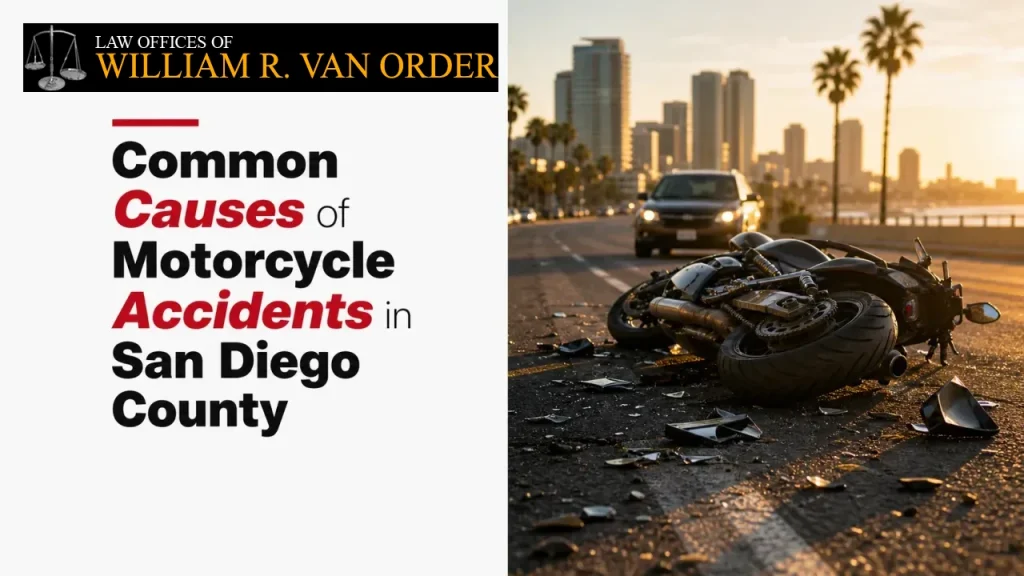
Common causes of motorcycle accidents in San Diego County include: drivers turning left in front of riders, unsafe lane changes, speed that is too fast for traffic or road conditions, distracted driving, impaired driving, poor visibility, and road hazards that may be minor for a car but dangerous for a motorcycle. In plain terms, many wrecks happen because another driver “just didn’t see” the rider—or because a small mistake became a big one at freeway speed.
For injured riders, knowing the common causes matters for two reasons. First, it helps you ride more defensively. Second, if a crash already happened, the cause often shapes who may be legally responsible, what evidence matters, and how an insurance company will try to value the claim. In San Diego County, that can mean looking at freeway traffic on I-5, I-8, I-15, and SR-78, heavy tourist traffic near the coast, or rural roadway conditions in the backcountry.
Quick Answer
The most common causes of motorcycle accidents in San Diego County include:
- Left-turn collisions at intersections
- Drivers changing lanes without checking blind spots
- Distracted driving
- Speeding or driving too fast for conditions
- Impaired driving
- Lane-splitting misunderstandings
- Road hazards such as debris, potholes, gravel, and uneven pavement
- Following too closely
- Poor weather or low-visibility conditions
- Dooring and parking-lot crashes in urban areas
California law allows lane splitting when done in a safe and prudent manner, and the California DMV driver handbook tells motorists that lane splitting is legal in the state. California Vehicle Code section 21658.1 defines lane splitting, and CHP safety guidance says it is typically safer between the far-left lanes than between other lanes.
The SR-1 requirement is separate from reporting the crash to law enforcement or an insurance company.
Why Motorcycle Crashes Are So Serious
A rider does not have the steel frame, airbags, or side-impact protection that people in passenger vehicles take for granted. So even a crash that starts as a “simple” lane change can lead to broken bones, head trauma, road rash, spinal injuries, or a long recovery.
The severity of the injuries can affect the legal and insurance issues that follow the severity of the injury often drives the legal issues that follow: emergency care, time off work, bike repairs or total loss, and arguments with insurance adjusters about fault. That is especially true when an insurer tries to blame the rider based on stereotypes rather than evidence.
Left-Turn Accidents at Intersections
This is one of the most common patterns. A driver turns left across traffic and misjudges the motorcycle’s speed or distance. Sometimes the driver never sees the rider at all. Intersections are already conflict points, and San Diego County traffic engineers regularly focus on intersection sight distance and turning movements because they affect crash risk. (sandiegocounty.gov)
For riders, these crashes often happen when:
- the motorcycle is going straight through an intersection,
- the driver is rushing to beat oncoming traffic,
- sunlight, glare, or congestion makes the bike less noticeable.
Unsafe Lane Changes
Freeway riding in Southern California comes with constant merging, weaving, and stop-and-go traffic. A driver may drift into a rider’s lane without checking mirrors or blind spots. That risk gets worse around on-ramps, exits, and congested commuter routes.
And when traffic bunches up, some drivers react abruptly. A quick lane move that would be a close call with another car can knock a rider down.
Distracted Driving
Phones remain a major problem. A distracted driver may fail to notice a motorcycle stopping ahead, moving through an intersection, or traveling alongside in traffic. Riders are smaller and easier to overlook than full-size vehicles, so distraction can be especially dangerous.
Speeding or Driving Too Fast for Conditions
Speed affects both drivers and riders. A motorcyclist may have less time to react to a turning vehicle or road debris. A speeding driver may also close distance too quickly and strike a rider from behind or during a lane change.
Even when a driver or rider is traveling at or below the posted speed limit, conditions such as curves, congestion, visibility, traffic, or roadway hazards may require a slower speed.
Impaired Driving
Alcohol and drugs remain a factor in serious crashes. The County of San Diego’s Local Roadway Safety Plan identifies motorcyclists as a challenge area and notes collisions involving operators under the influence among the county’s safety concerns. (sandiegocounty.gov)
Impairment affects judgment, reaction time, and lane control. For riders, that combination can be unforgiving.
How Does Lane Splitting Affect Motorcycle Accident Claims?
Lane splitting gets a lot of attention after a crash, and sometimes for the wrong reasons.
The practice is defined in Vehicle Code section 21658.1, and CHP states that lane splitting is legal if done in a safe and prudent manner. The DMV handbook also tells drivers to expect motorcycles to share lanes. (dmv.ca.gov)
That does not mean every lane-splitting move is safe. But it also does not mean the rider is automatically at fault. Liability depends on the facts, including:
- traffic speed,
- spacing between vehicles,
- whether a driver changed lanes suddenly,
- whether the rider was traveling at an unsafe speed,
- road and visibility conditions.
An insurer may argue that a rider's lane splitting contributed to the crash, but lane splitting alone does not establish fault.
What Road Conditions Cause Motorcycle Wrecks?
Motorcycles react differently to roadway defects than cars do. Something a sedan rolls over without much trouble may send a rider sliding.
Common roadway hazards include:
- potholes,
- uneven pavement,
- gravel or sand,
- oil slicks,
- standing water,
- loose debris,
- poor construction-zone transitions,
- faded lane markings.
San Diego County includes coastal roads, canyon routes, suburban arterials, and rural roads. Those road types create different hazards. Near the coast, tourist traffic and frequent stopping can raise collision risk. Inland and rural areas may bring sharper curves, shoulder drop-offs, and debris.
Local agencies also continue roadway improvement projects involving left-turn lanes, roundabouts, and traffic operations, which shows how road design can affect safety. (sandiegocounty.gov)
Are Drivers Usually at Fault in Motorcycle Accidents?
Not always. But in many motorcycle injury cases, another driver bears at least part of the blame. California uses a comparative fault system, which means more than one person can share responsibility. If a rider was partly at fault, that may reduce damages rather than bar recovery altogether. (How that applies depends on the evidence and the specific facts.)
Examples:
- A driver turns left in front of a rider, but the rider may also have been speeding.
- A car changes lanes into a motorcycle, but the rider may have been lane splitting too fast for conditions.
- A rear-end collision happens, but there may be a dispute about abrupt braking or visibility.
That is why evidence matters so much.
What Evidence Helps Prove the Cause of a Motorcycle Crash?
If you can safely gather evidence after a crash—or have someone do it for you—it can make a real difference later.
Helpful evidence often includes:
- Photos of the scene, vehicle damage, skid marks, roadway defects, debris, and visible injuries
- Names and contact information for witnesses
- Police or CHP report information
- Helmet, riding gear, and damaged motorcycle parts
- Traffic camera, dashcam, or nearby surveillance footage
- Medical records linking the injuries to the crash
- Cell phone records, if distraction may be an issue
- Repair estimates or total-loss documentation
One practical point people miss: if a roadway condition contributed to the crash, photographs need to be taken quickly. Potholes get patched. Debris gets cleared. Construction setups change fast.
What Should You Do After a Motorcycle Accident in California?
Even though this article focuses on causes, the immediate steps after a crash matter.
- Get medical help right away and call 911 if anyone may be hurt.
- Move to safety if you can do so without making injuries worse.
- Exchange information with the other driver.
- Take photos and video of the scene, vehicles, roadway, and injuries.
- Get witness names and phone numbers.
- Report the crash to your insurer promptly.
- Be careful about recorded statements to the other side’s insurance carrier.
- Keep your helmet, riding gear, and damaged motorcycle in the same condition if possible.
- Follow up with medical treatment.
- Speak with a California personal injury attorney if fault, injuries, or insurance coverage are disputed.
California also requires an SR-1 report to the DMV within 10 days if anyone was injured or killed, or if property damage exceeds $1,000. That report is separate from any police report or insurance claim. (qr.dmv.ca.gov)
How Insurance Companies Often Approach Motorcycle Claims
Insurance companies may investigate motorcycle claims closely and may question issues such as speed, lane splitting, visibility, or the extent of the rider's injuries. In many cases, adjusters look for ways to shift blame to the rider by arguing:
- the rider was speeding,
- lane splitting was unsafe,
- dark clothing reduced visibility,
- the rider “came out of nowhere,”
- the injuries were not as serious as claimed.
California’s minimum auto liability limits increased beginning January 1, 2025, to $30,000 per person, $60,000 per accident, and $15,000 for property damage on standard auto policies. Those minimums may still be far too low in a serious motorcycle injury case. (insurance.ca.gov)
So coverage issues can become a major part of the claim, especially where there are significant medical bills or lost earnings.
Common Mistakes to Avoid
A few avoidable mistakes can hurt an otherwise valid claim:
- Admitting fault at the scene before the facts are known
- Skipping medical care because you think you are “just sore”
- Repairing or disposing of the motorcycle too quickly
- Assuming lane splitting automatically ruins your case
- Giving a broad recorded statement without preparation
- Posting about the crash on social media
- Missing the DMV reporting requirement
And one more: waiting too long to get legal guidance. Evidence has a shelf life.
When Should You Speak With a Motorcycle Accident Lawyer?
It usually makes sense to talk with a lawyer if:
- you suffered more than minor injuries,
- fault is disputed,
- the insurer is blaming you for lane splitting,
- there may be a roadway defect claim,
- the other driver was uninsured or underinsured,
- your losses include missed work or ongoing treatment.
A lawyer can help identify the real cause of the crash, preserve evidence, deal with insurers, and explain what deadlines may apply. Deadlines can depend on the facts, and claims involving public entities may involve special notice rules and shorter time limits.
General information is helpful. Specific legal advice requires a review of your case.
Conclusion
The common causes of motorcycle accidents in San Diego County are usually not mysterious. Most involve left-turn conflicts, lane changes, distraction, speed, impairment, or road hazards. But proving exactly what happened—and who is legally responsible—is another matter.
If you were injured in a motorcycle crash in San Diego County, the cause of the collision can affect both liability and the insurance claims process. The Law Offices of William R. Van Order handles personal injury matters involving motorcycle and other motor-vehicle accidents. A consultation can help you understand what evidence may matter and what legal options may be available based on the circumstances of your crash.
Attorney Advertising / Disclaimer: This article provides general information about California motorcycle accident claims and is not legal advice. Reading it does not create an attorney-client relationship. Laws and procedures can change, and deadlines may depend on the specific facts. For advice about your situation, speak directly with a California attorney.