

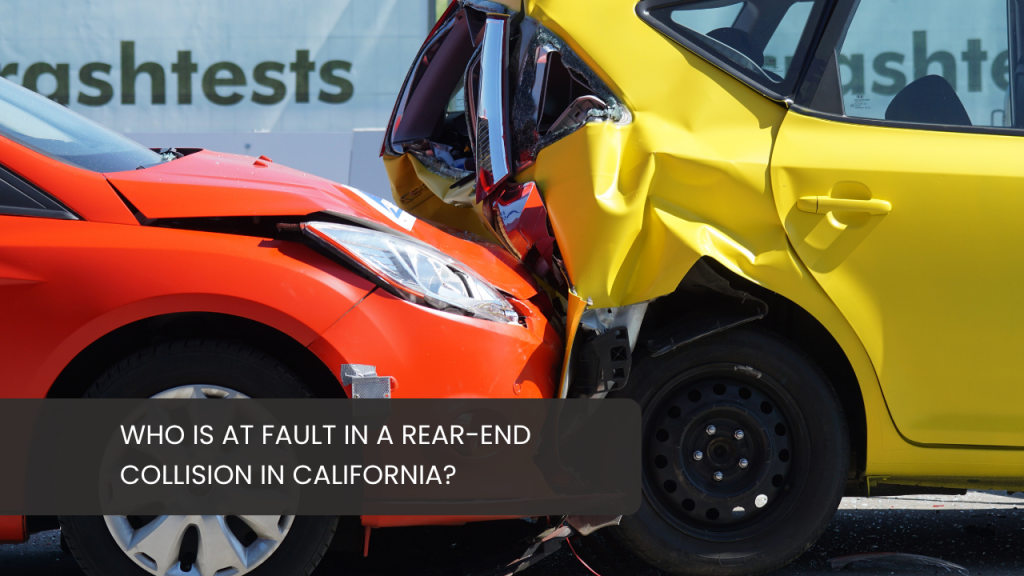
In California, the driver who strikes another vehicle from behind is often considered responsible, particularly when the evidence shows that the rear driver was following too closely, driving too fast for conditions, or otherwise failed to operate the vehicle with reasonable care. California Vehicle Code §21703 requires drivers to maintain a following distance that is reasonable and prudent based on the speed of the vehicles, traffic, and roadway conditions.
However, a rear-end collision does not automatically make the rear driver 100% at fault. California courts have recognized that rear-end collisions generally involve factual questions about what each driver did before the crash. A rear-end impact can be evidence of negligence by the following driver, but the circumstances may show that the driver in front or another party also contributed to the collision.
That distinction matters if you were injured in a collision in La Jolla, San Diego County, Hemet, Palm Springs, or elsewhere in Southern California. Determining fault may require examining traffic conditions, braking, lane changes, visibility, vehicle damage, witness statements, video, and other evidence rather than simply asking which vehicle hit the other.
Important: This article provides general information about California law. It is not legal advice and does not create an attorney-client relationship.
What Does California Law Say About Rear-End Collisions?
California does not have a rule stating that the rear driver is automatically liable every time one vehicle hits another from behind.
Instead, ordinary negligence principles and California traffic laws may be relevant.
California Vehicle Code §21703 and following too closely
California Vehicle Code §21703 provides that a driver may not follow another vehicle more closely than is reasonable and prudent, considering the speed of the vehicle ahead, traffic, and roadway conditions.
This means there is no single legally required number of feet that every driver must maintain behind another vehicle. A reasonable following distance depends on the circumstances.
For example, a following distance that might be adequate in light traffic on a dry road may not be reasonable when:
- Traffic is moving quickly.
- Vehicles are stopping frequently.
- The roadway is wet.
- Visibility is poor.
- Traffic is congested.
- The road is icy or otherwise hazardous.
- The driver is traveling downhill.
- The vehicle ahead is slowing unexpectedly.
The California Highway Patrol also identifies speed, traffic, and roadway conditions as considerations under Vehicle Code §21703.
California’s basic speed law may also matter
Vehicle Code §22350 requires drivers to operate at a speed that is reasonable and prudent given circumstances such as traffic, weather, visibility, and roadway conditions.
A driver can therefore potentially contribute to a rear-end collision by traveling too fast for the conditions even if the driver was not exceeding the posted speed limit.
For example, a driver traveling at the posted speed limit may still have difficulty defending against a negligence claim if traffic, rain, visibility, or another roadway condition required a slower speed.
Is the Rear Driver Automatically at Fault?
No.
This is one of the most important points to understand about rear-end collisions in California.
California appellate decisions have explained that when one vehicle strikes the rear of another, the collision can provide evidence of negligence by the following driver, but negligence is not necessarily established as a matter of law solely because a rear-end collision occurred. The circumstances surrounding the collision still matter.
In other words:
Rear driver hits front vehicle → evidence that may support negligence → investigation of the circumstances → determination of responsibility.
That is different from saying:
Rear driver hits front vehicle → rear driver is automatically 100% legally responsible.
The distinction can become particularly important when the front vehicle stopped suddenly, changed lanes, had defective equipment, or otherwise contributed to the collision.
When Is the Rear Driver Likely to Be Responsible?
The rear driver may be responsible when evidence shows that the collision resulted from the driver’s failure to use reasonable care.
Common examples include:
Following too closely
If a driver follows another vehicle too closely and cannot stop when traffic slows, Vehicle Code §21703 may be relevant.
Distracted driving
A driver who is looking at a phone, adjusting a navigation system, reaching for something, or otherwise failing to pay attention may have difficulty explaining why they could not respond to traffic ahead.
Excessive or unsafe speed
A driver traveling too quickly for traffic, visibility, weather, or road conditions may not have enough time to stop safely.
Failing to react appropriately
Even if a driver was initially maintaining an appropriate distance, the circumstances may raise questions about whether the driver responded reasonably after recognizing a hazard.
Driving under the influence
If impairment contributed to the collision, it can create additional legal and factual issues beyond the ordinary negligence analysis.
The important question is not simply “Who hit whom?” It is “What conduct caused or contributed to the collision?”
When Could the Driver in Front Be at Fault?
The driver in front can potentially contribute to a rear-end collision.
California courts have recognized that the conduct of the lead driver may be relevant when determining the cause of a rear-end accident. In one California appellate decision, the court explained that the jury could consider the conduct of both drivers in determining whether the rear driver’s conduct was a proximate cause of the accident.
Potential examples include:
An unsafe or unexpected lane change
If the front vehicle moves into another lane in a way that creates an immediate hazard, the circumstances may affect the allocation of responsibility.
An unreasonable or unexplained stop
A driver may need to explain why and how the vehicle stopped, particularly when the circumstances suggest an unexpected or hazardous maneuver.
Defective brake lights
If brake lights were not functioning and that contributed to another driver’s inability to recognize that the vehicle was stopping, the issue may become relevant to fault.
Reversing into another vehicle
A collision that appears to be a rear-end accident may actually involve a vehicle moving backward, which can materially change the analysis.
Other unsafe driving
Sudden maneuvers, improper turns, or other negligent conduct by the lead driver can potentially contribute to the accident.
These situations do not automatically make the front driver responsible. The evidence must be evaluated in context.
What If the Driver in Front Suddenly Slams on the Brakes?
A sudden stop does not automatically make the front driver responsible.
Drivers are generally expected to anticipate that traffic can slow or stop and to maintain enough distance to respond safely. At the same time, the reason for the sudden stop and what happened immediately before the collision can be important.
For example, consider two different situations:
Example 1: Traffic ahead is slowing, the lead driver brakes normally, and the following driver is too close to stop safely.
The evidence may support responsibility by the following driver.
Example 2: The lead driver makes an unexpected maneuver or stops under unusual circumstances, and the evidence suggests that the following driver was otherwise driving reasonably.
The facts may support a different allocation of responsibility.
California courts have repeatedly treated rear-end collisions as fact-specific rather than automatically resolving fault against one driver.
What If Both Drivers Were at Fault?
Both drivers can potentially share responsibility.
California Department of Insurance consumer guidance explains comparative negligence as the percentage of responsibility each driver shares when both drivers are at fault.
For example, imagine that a rear driver was following too closely, but the evidence also shows that the front driver made an unsafe maneuver that contributed to the collision.
The parties could dispute how responsibility should be allocated.
This is why an injured person should not assume that:
- “I was rear-ended, so I automatically win,” or
- “I was driving the rear vehicle, so I cannot recover anything.”
The legal result depends on the evidence and applicable law.
How Is Fault Determined After a California Rear-End Collision?
Fault may be evaluated using many different sources of evidence.
Police reports
A police report may contain statements from drivers and witnesses, observations by the responding officer, diagrams, citations, and other information.
However, a police report does not necessarily resolve every issue of civil liability.
Photographs and videos
Photographs can show:
- Vehicle damage
- Vehicle positions
- Traffic signals
- Road conditions
- Skid marks
- Debris
- Lane markings
- Visibility
- Nearby signs
Dashcam footage, surveillance video, or other recordings may also be important.
Vehicle damage
The location and pattern of damage can sometimes help reconstruct how the collision occurred.
For example, damage concentrated on the rear of one vehicle and front of another may support one version of events, but the damage alone does not necessarily establish every aspect of fault.
Witness statements
Independent witnesses may provide information about:
- Traffic conditions
- Vehicle speed
- Lane position
- Braking
- Sudden movements
- What happened immediately before impact
Vehicle and electronic evidence
Depending on the circumstances, potentially relevant evidence may include dashcam recordings, photographs stored on phones, surveillance footage, and certain vehicle data.
Medical records
If someone was injured, medical records can help document the nature and treatment of the injury and may become important in determining damages.
California Courts advises people involved in personal injury cases to keep evidence related to the injury and explains that damages may include medical bills, lost wages, ongoing treatment, emotional harm, and future problems caused by the injury.
Does a Rear-End Collision Usually Mean the Other Driver’s Insurance Pays?
Not necessarily.
Insurance coverage and liability are related but separate questions.
An insurer may investigate:
- How the collision happened
- Which drivers were involved
- Whether a driver violated traffic laws
- Whether either driver contributed to the accident
- The extent of the claimed injuries
- Available insurance coverage
- Vehicle damage
- Other evidence
The California Department of Insurance explains that an insurance adjuster may investigate and evaluate damage and losses after an accident. It also explains that California auto policies can include liability coverage and uninsured/underinsured motorist coverage.
If you were injured, the amount and type of available insurance coverage can become important, particularly when the at-fault driver’s policy limits are limited or the other driver has little or no insurance.
What Evidence Should You Collect After a Rear-End Collision?
If you are physically able to do so and it is safe, preserve evidence as soon as possible.
Consider obtaining:
- Photos of your vehicle
- Photos of the other vehicle
- Photos of the accident scene
- Photos of traffic signs and signals
- Witness contact information
- The other driver’s insurance information
- The police report number
- Medical records
- Medical bills
- Prescription records
- Documentation of missed work
- Photographs of visible injuries
- Dashcam footage
- Relevant text messages or communications
- Insurance correspondence
Do not put yourself in danger to obtain photographs or other evidence.
If you were transported from the scene for emergency treatment, for example, your immediate priority should be medical care. Evidence can be gathered afterward.
What Should You Do If You Were Injured in a Rear-End Collision?
If you were injured, consider taking these steps:
1. Get appropriate medical attention
Some injuries may require immediate treatment. Others may become apparent later.
Follow your healthcare provider’s recommendations and keep records of treatment.
2. Report the accident appropriately
California has accident-reporting requirements that may apply depending on the circumstances. You should also comply with your insurance policy’s reporting requirements.
3. Preserve evidence
Keep photographs, medical records, bills, witness information, and insurance communications.
4. Avoid guessing about fault
If you do not know exactly how or why something happened, do not invent an explanation.
5. Be cautious before settling an injury claim
An early settlement offer may not reflect the full scope of an injury, particularly if treatment is ongoing.
6. Consider legal advice when the circumstances warrant it
California Courts identifies severe or long-term injuries, substantial potential damages, and uncertainty about who is responsible as circumstances in which speaking with a lawyer may be particularly important.
What Damages May Be Available After a Rear-End Collision?
If another person’s negligence caused an injury, potential damages can depend on the circumstances of the case.
They may include economic losses such as:
- Medical expenses
- Future medical treatment
- Lost wages
- Loss of earning capacity
- Other financially measurable losses
Non-economic damages may also be available in appropriate cases, including:
- Physical pain
- Emotional distress
- Mental suffering
- Inconvenience
- Loss of enjoyment of life
California Courts identifies medical bills, lost wages, emotional harm, ongoing treatment, and future problems among the losses that can be relevant in personal injury cases.
The availability and amount of damages depend on the facts and applicable law. No responsible attorney can guarantee a particular settlement or recovery without evaluating the individual case.
What If the Other Driver Says You Caused the Rear-End Accident?
Do not assume that the other driver’s statement settles the matter.
Insurance companies may investigate competing versions of an accident. Evidence such as photographs, witness statements, vehicle damage, traffic-camera footage, and medical records may help establish what happened.
If you are contacted by an insurer, provide accurate information, but be careful about making speculative statements about fault or the extent of injuries.
The California Department of Insurance recommends reporting accidents promptly to your insurer and explains that insurers may assign adjusters to investigate and evaluate claims.
What If the Other Driver Has No Insurance?
A rear-end collision caused by an uninsured driver can create additional insurance issues.
California Department of Insurance guidance explains that uninsured/underinsured motorist coverage can provide protection in qualifying situations when another driver is at fault and does not have insurance or does not have enough insurance.
Review your own policy to determine what coverage you have.
Do not assume that an uninsured driver means you have no potential source of recovery. At the same time, coverage depends on the specific policy and circumstances.
How Long Do You Have to File a Rear-End Collision Injury Lawsuit in California?
California Courts states that the general statute of limitations for a personal injury claim is two years from the date of the injury. Property-damage claims generally have a different deadline.
However, this is not a universal deadline for every accident-related claim.
Different rules may apply depending on:
- Who is being sued
- Whether a government entity is involved
- When an injury was discovered
- The type of claim
- Other legally significant circumstances
California Courts specifically warns that statutes of limitation are fact-specific and can be difficult to calculate. Claims involving government agencies can have different and potentially shorter requirements.
If you were injured in a rear-end collision, consult a California attorney regarding the deadline applicable to your circumstances rather than relying solely on the general two-year rule.
When Should You Speak With a California Personal Injury Attorney?
You may want to consider speaking with a personal injury attorney when:
- You suffered significant injuries.
- Your symptoms are continuing or worsening.
- You may require future medical treatment.
- The other driver disputes fault.
- Both drivers may have contributed to the collision.
- Multiple vehicles were involved.
- A commercial vehicle was involved.
- The at-fault driver has limited or no insurance.
- Your ability to work has been affected.
- The insurance company disputes your claim.
- You receive a settlement offer and are unsure whether it is adequate.
- You are asked to sign a release.
- A government vehicle or government entity may be involved.
- You are approaching a legal deadline.
California Courts notes that legal assistance can be particularly important when injuries are severe or long-term, potential damages are substantial, or responsibility is unclear.
The Law Offices of William R. Van Order focuses on personal injury matters and serves clients in La Jolla, Hemet, Palm Springs, and throughout Southern California. A California personal injury attorney can review the facts of an individual collision and explain the legal options that may be available.
Common Mistakes to Avoid After a Rear-End Collision
Assuming the rear driver is automatically 100% at fault
A rear-end impact can be strong evidence of negligence by the following driver, but California law looks at the circumstances of the particular collision.
Assuming you have no claim because the damage looks minor
Vehicle damage does not necessarily tell the entire story about an individual’s injuries.
Delaying medical care without a good reason
If you have symptoms, obtain appropriate medical attention and follow medical advice.
Failing to preserve evidence
Photographs, witness information, video, medical records, and other evidence can become difficult to obtain later.
Giving inconsistent or speculative statements
Stick to facts you know. Avoid guessing about speed, distances, timing, or other details you cannot accurately remember.
Settling too quickly
Before accepting a final settlement, make sure you understand what claims and future losses the settlement is intended to resolve.
Waiting until the deadline is approaching
California Courts warns that statutes of limitation can be complicated and fact-specific. Waiting too long can jeopardize a claim.
Frequently Asked Questions
Is the person who rear-ends another car always at fault in California?
No. A rear-end collision often provides evidence that the following driver may have been negligent, particularly if the driver was following too closely or traveling too fast for conditions. But California courts have recognized that rear-end collisions are generally fact-specific. The conduct of the front driver and other circumstances can also affect responsibility.
What California law applies to following too closely?
California Vehicle Code §21703 prohibits a driver from following another vehicle more closely than is reasonable and prudent, considering the speed of the vehicle ahead, traffic, and roadway conditions. The law does not establish one universal following distance that applies in every situation. Whether the following distance was reasonable depends on the circumstances.
Can the front driver be partially responsible for a rear-end crash?
Yes. The front driver’s conduct can be relevant when determining how a collision occurred and whether another driver was negligent. Circumstances such as an unsafe maneuver, an unusual stop, or another negligent act may become relevant. However, the existence of one of these circumstances does not automatically establish fault; the evidence must be evaluated as a whole.
What if the driver in front suddenly stopped?
A sudden stop does not automatically make the front driver responsible. The circumstances matter, including traffic conditions, the reason for stopping, whether the stop was reasonably foreseeable, and the following driver’s speed and distance. California courts have treated rear-end collisions as factual questions that generally depend on the circumstances surrounding the accident.
Can I recover compensation if I was partly at fault?
Potentially. California recognizes comparative negligence, meaning responsibility can be divided when more than one person contributed to an accident. The California Department of Insurance describes comparative negligence as the percentage of responsibility each driver shares when both are at fault. The effect on a particular injury claim depends on the facts and applicable law.
What evidence can prove fault in a rear-end collision?
Potential evidence includes photographs, vehicle damage, witness statements, police reports, dashcam or surveillance footage, roadway conditions, traffic signals, medical records, and other documentation. No single piece of evidence necessarily determines fault. The evidence should be evaluated together to determine what happened and whether a driver’s conduct contributed to the collision.
How long do I have to bring a personal injury claim after a rear-end collision?
California Courts states that the general deadline for a personal injury lawsuit is two years from the date of injury. However, exceptions and different deadlines can apply, including claims involving government entities or other special circumstances. Because the correct deadline is fact-specific, an injured person should consult a California attorney about the deadline that applies to their particular case.
Should I hire a lawyer after being rear-ended?
Not every rear-end collision requires an attorney. Legal advice may be particularly useful when the injuries are serious or ongoing, fault is disputed, multiple parties are involved, insurance coverage is complicated, or an insurer has made a settlement offer. California Courts specifically identifies severe injuries, significant potential damages, and uncertainty about responsibility as situations where legal assistance may be important.
Conclusion: Who Is at Fault in a Rear-End Collision in California?
So, who is at fault in a rear-end collision in California?
In many cases, the driver who strikes the vehicle ahead will face significant evidence that their driving contributed to the collision, particularly when the evidence indicates following too closely, unsafe speed, distraction, or another failure to use reasonable care. California Vehicle Code §21703 specifically addresses following too closely.
But rear-end collision fault in California is not automatically decided solely by which vehicle struck the other from behind. California courts have recognized that these cases are generally fact-specific. The conduct of the front driver, roadway conditions, traffic, braking, lane changes, visibility, vehicle condition, and other evidence may affect the determination of responsibility.
If you were injured in a rear-end collision in La Jolla, Hemet, Palm Springs, San Diego County, or elsewhere in Southern California, preserving evidence and understanding your legal rights can be important. The Law Offices of William R. Van Order handles personal injury matters and can evaluate the specific circumstances of an accident when legal representation is appropriate.
Attorney Disclaimer
This article is provided for general informational and educational purposes only. It is not legal advice and does not create an attorney-client relationship. California personal injury law can depend on the specific facts, applicable statutes, insurance coverage, evidence, and procedural requirements. Laws and legal interpretations can change. If you have been injured in a rear-end collision, consult a qualified California attorney regarding your specific circumstances.