

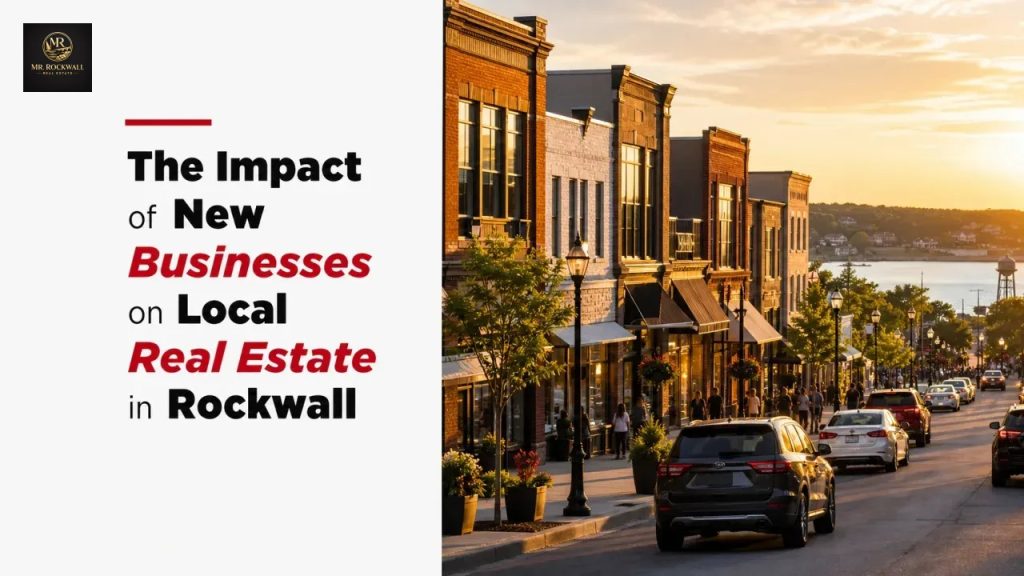
New businesses are having a real effect on local real estate in Rockwall. As more retail, dining, office, and mixed-use development shows up along the I-30 corridor, Downtown, and The Harbor area, buyer interest, traffic patterns, and home-value perceptions tend to shift with it. For anyone watching the Rockwall housing market, business growth is one of the clearest signals to track.
Rockwall isn’t growing in a vacuum. The city has added more than 2.4 million square feet of new non-residential space since 2021, valued at about $494 million, and city documents say commercial development along IH-30 has helped position Rockwall as a regional retail center. The same report notes retail vacancy at the end of 2024 was just 3.98%, which is unusually tight. (new.rockwall.com)
That matters because commercial momentum often changes how people judge a place to live. A city with more shopping, restaurants, services, jobs, and entertainment usually feels more convenient day to day. In Rockwall, that convenience shows up in practical ways: easier errands, more dining options, stronger visitor traffic around Lake Ray Hubbard, and more activity around major corridors like I-30 and Ridge Road. Visit Rockwall also highlights The Harbor as a waterfront entertainment district with restaurants, events, and year-round activity. (visitrockwall.com)
How do new businesses affect home values in Rockwall?
New businesses usually support home values by making an area more useful, more visible, and more desirable to buyers. In Rockwall, that effect is strongest near major retail corridors, destination areas, and neighborhoods that benefit from improved convenience without taking on too much traffic or noise.
Think about how buyers shop. Many aren’t just comparing square footage or lot size. They’re asking how fast they can get to groceries, restaurants, coffee shops, medical services, and weekend entertainment. If a neighborhood gives them all of that within a short drive, or even better, a short walk in select pockets, it often earns more attention.
City planning records specifically identify big commercial projects including H-E-B and IKEA, while noting the IH-30 corridor’s importance as Rockwall’s principal commercial and retail corridor. That kind of investment tends to reinforce buyer confidence, especially for households relocating from Dallas-area suburbs that want convenience without giving up a smaller-city feel. (new.rockwall.com)
At the same time, not every business opening raises values equally. A thoughtfully placed grocery anchor, dining cluster, or lifestyle retail center can lift nearby appeal. Heavy traffic generators or poorly integrated commercial uses can create friction. In most cases, the sweet spot is “close, but not too close.”
Which parts of Rockwall benefit the most from business growth?
The areas that usually benefit most are the ones with good access to jobs, shopping, and entertainment while still preserving neighborhood appeal. In Rockwall, that often means homes near the I-30 corridor, The Harbor, Downtown, and well-connected residential areas with easy access to Ridge Road and Goliad.
The Harbor is a good example. It combines dining, hospitality, events, and lakefront identity in a way that adds lifestyle value beyond basic retail. Visit Rockwall describes it as a lively waterfront district with restaurants, shopping, concerts, and views over Lake Ray Hubbard. That type of placemaking can have a stronger emotional effect on buyers than a standard strip center. (visitrockwall.com)
Downtown Rockwall also benefits differently. There, the draw is character. Boutique retail, preserved buildings, local eateries, and event activity help create a place people want to spend time in. Buyers who care about charm and local identity often pay attention to that. And when older neighborhoods see reinvestment alongside commercial growth, it can strengthen demand in nearby housing stock. City documents note reinvestment in areas including Downtown, Lakeside Village, and Chandler’s Landing. (new.rockwall.com)
What does the current Rockwall housing market say about this trend?
The Rockwall housing market in mid-2026 looks active but more balanced than the ultra-competitive years buyers saw earlier in the decade. That makes business growth even more important, because strong local amenities can help one neighborhood stand out when buyers have more choices.
Here’s a quick market snapshot from current public housing data:
| Metric | This period | Trend |
|---|---|---|
| Median sale price | $492,705 | Down 7.0% year over year (Redfin, May 2026) |
| Median days on market | 96 | Up from 64 a year earlier (Redfin, May 2026) |
| Homes sold | 224 | Up 10.6% year over year (Redfin, May 2026) |
| Typical home value | $481,124 | Down 1.3% year over year (Zillow, June 2026) |
| For-sale inventory | 510 | Active listings reported by Zillow (June 2026) |
What does that mean in plain English? Buyers have a bit more room to compare homes, and sellers can’t rely on market heat alone. In that kind of environment, neighborhoods tied to strong business growth, visible investment, and everyday convenience often hold attention better than areas with fewer location advantages.
Why do buyers care so much about new restaurants, retail, and services?
Buyers care because business growth changes daily life, not just market statistics. A new grocery store, a better dining cluster, or more nearby services can make a home feel more practical. And practical usually sells.
This shows up especially with relocation buyers. Someone moving to Rockwall may first notice schools, commute routes, and price point. But the next questions are usually local: Where do we shop? Where do we go on weekends? Is there enough to do? Can we stay local for dinner, errands, and entertainment?
Rockwall has been building a stronger answer to those questions. The city’s tourism and destination materials point to The Harbor, Historic Downtown, local restaurants, hotels, and live-event activity as part of the city’s appeal. That broader experience matters because people don’t buy a house in isolation; they buy into a routine. (visitrockwall.com)
What does business growth mean for buyers and sellers in Rockwall?
For buyers, business growth can be both an opportunity and a warning sign. For sellers, it can strengthen positioning if the home is in the right location and priced well for the current market.
Here’s the simple breakdown:
| Group | What new businesses can mean |
|---|---|
| Buyers | More confidence in long-term area demand, stronger amenities, and better resale potential in well-located neighborhoods |
| Sellers | Better marketing story, especially if the home offers access to dining, shopping, entertainment, or major commuting routes |
| Investors | More tenant appeal near activity centers, but also more pressure to buy only where numbers still make sense |
| Move-up households | A reason to stay in Rockwall instead of leaving for larger suburbs with more retail depth |
A practical example: a home with quick access to The Harbor, Downtown, or the I-30 retail corridor may attract more online clicks than a similar home in a less convenient pocket. That doesn’t guarantee a higher sale price, but it often improves buyer interest.
Are there any downsides when new businesses come into a market like Rockwall?
Yes, there can be tradeoffs. New business growth can bring traffic, noise, pressure on infrastructure, and shifts in neighborhood feel. In Rockwall, the challenge is keeping growth useful without losing the character that made people want to move there in the first place.
That’s especially relevant near major corridors. City materials and planning documents repeatedly point to I-30 as the city’s primary commercial gateway, and ongoing transportation work can affect how convenient certain areas feel in the short term. (rockwall.com)
Buyers should pay attention to more than the headline “growth.” Look at ingress and egress, traffic counts at peak hours, buffer space between residential and commercial uses, and whether the development adds needed services or just adds congestion. A new business boom is positive only when the surrounding neighborhood still functions well for everyday living.
Is Rockwall still a good place to buy real estate as business growth continues?
For many buyers, yes. Rockwall still offers a mix that’s hard to find: lake access, a recognizable downtown, strong retail momentum, and suburban housing options within reach of the Dallas area. Business growth doesn’t replace fundamentals, but it does add another layer of long-term appeal.
The housing numbers suggest a market that is no longer in frenzy mode. Realtor.com describes conditions in the broader Rockwall market as favorable for buyers as inventory rises modestly and days on market lengthen. That kind of reset can give buyers time to choose location carefully, which is exactly when business-growth patterns matter most. (realtor.com)
If you’re thinking about buying a home in Rockwall or trying to sell my home in Rockwall, the key isn’t just whether businesses are opening. It’s which businesses, where they’re landing, and how they change the appeal of specific neighborhoods. That’s where local knowledge makes a difference.
If you want help reading the Rockwall housing market through a truly local lens, talk with a knowledgeable Rockwall real estate agent who can connect business growth, neighborhood demand, and home values at the street level.