

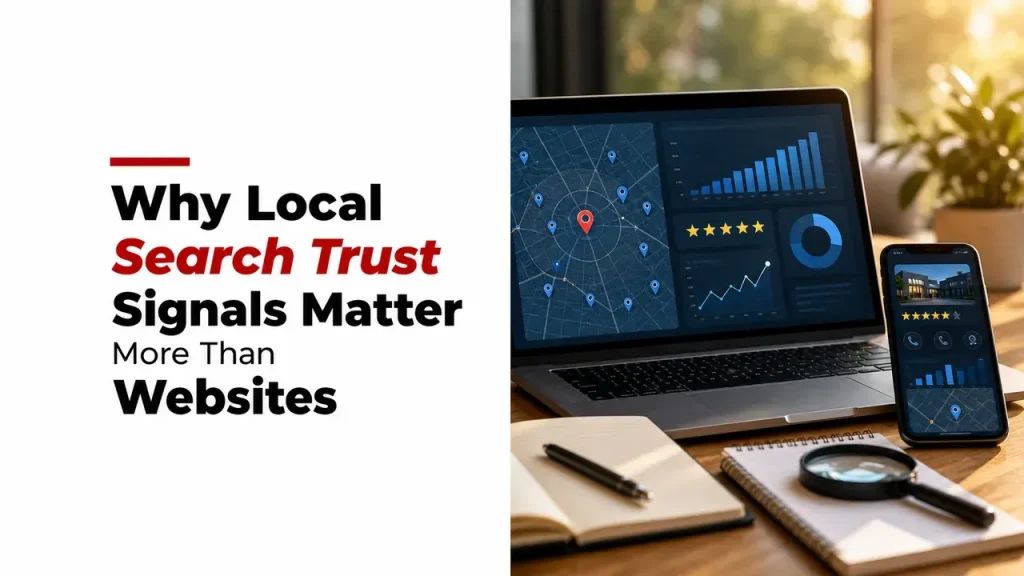
Why local search trust signals matter more than websites is a question more buyers, sellers, and agents are asking in 2026. The short answer is simple: people usually trust what Google, Maps, reviews, and consistent local proof show them before they trust what an agent says on a website.
Table of Contents
-
-
- Blog Outline
- Full Blog Article
- What Local Search Trust Signals Actually Are
- Why Websites Lost Their Position as the First Trust Check
- The Trust Signals Buyers and Sellers Notice First
- How Designated Local Expert Uses Local Trust Signals
- What This Means for Home Sellers
- What This Means for Home Buyers
- Why This Also Matters to Real Estate Agents
- Simple Steps to Improve Local Search Trust
- Conclusion
- FAQs
-
What Local Search Trust Signals Actually Are
Local search trust signals are the public signs that show an agent or business is real, active, relevant, and trusted in a specific city. These signals include Google Business Profile data, Google reviews, map visibility, local citations, recent photos, Q&A activity, and city-specific content. As of May 2026, this public proof often shapes first impressions faster than a homepage does. And honestly, that makes sense because buyers and sellers want third-party validation, not just polished marketing copy. A website still matters, of course. But here’s the thing: your website is what you say about yourself, while local search signals are what the market says about you.Why Websites Lost Their Position as the First Trust Check
A website used to be the digital front door. Now, for many people, Google search results and Google Maps are the front door. Someone searching best local real estate agent near me is not usually reading five full websites first. In most cases, they are scanning:-
-
- star ratings
- review count
- map placement
- business category relevance
- recent activity
- location consistency
- signs of local expertise
-
The Trust Signals Buyers and Sellers Notice First
Buyers and sellers are fast judges online. They often make a short list in minutes. Here are the trust signals that usually matter most:-
-
- Google Business Profile for real estate agents with complete, accurate details
- High-quality reviews that mention neighborhoods, service, and results
- Recent photos that show listings, closings, and local activity
- Consistent NAP data (name, address, phone) across the web
- City-specific content tied to real neighborhoods and search intent
- Local map visibility for relevant real estate searches
- Authority mentions on trusted platforms and directories
-
How Designated Local Expert Uses Local Trust Signals
Designated Local Expert is built around a simple idea: local authority should be visible, verifiable, and easy for consumers to trust. That means DLE agents are not just trying to look good on a website; they are working to become the clearest trusted choice in their city. For sellers, that matters because visibility drives listing opportunities. For buyers, it matters because a buy a home with a local expert agent search should lead to someone who actually knows the streets, school zones, pricing patterns, and buyer competition in that market. DLE members are positioned as top real estate agents in my city through:-
-
- Strong city-based branding
- Search-first trust building
- Review and reputation development
- Google and AI visibility strategy
- Local content built around real buyer and seller questions
-
What This Means for Home Sellers
Homeowners who want to sell my home for top dollar fast usually focus on pricing, photos, and staging first. Those are important, but trust and discoverability matter just as much. Why? Because sellers are not only hiring an agent to put a home in the MLS. They are hiring an agent to attract attention, build buyer confidence, and create demand. A strong local listing agent marketing strategy now includes:-
-
- a visible Google Business Profile
- trusted reviews from local clients
- local SEO pages tied to city searches
- map relevance
- authority content that answers seller questions
- AI-friendly content structure
-
What This Means for Home Buyers
Buyers want speed, accuracy, and local insight. A generic website can say, “I know the area,” but reviews, maps, and local content can actually prove it. That proof matters when you are choosing between agents. Real estate agents with local market expertise tend to show their value in public ways:-
-
- neighborhood-specific reviews
- local market guides
- map visibility
- recent transaction signals
- consistent city relevance across search platforms
-
Why This Also Matters to Real Estate Agents
Agents should pay close attention here because this is not just a branding issue. It is a lead generation issue. If you want to know how to get more real estate leads online, start by asking a blunt question: does the public web confirm your expertise, or only your own website? That gap is where many agents lose business. Real estate SEO for agents is no longer just about ranking a homepage. It now includes:-
-
- Google Business Profile optimization
- review generation systems
- local entity relevance
- citation accuracy
- AI-readable content
- city-based authority pages
- trust signals across platforms
-
Simple Steps to Improve Local Search Trust
If you are a homeowner choosing an agent, a buyer researching local pros, or an agent trying to grow, start with the basics. Small fixes can make a real difference.For consumers
-
-
- Check Google reviews for specific local details
- Compare review count and recency
- Look at Google Maps presence
- Read neighborhood or city-specific articles
- Confirm the agent is active and visible in your area
-
For agents
-
- Claim and fully complete your Google Business Profile.
- Ask for detailed reviews after each closing.
- Publish city and neighborhood content regularly.
- Keep your business information consistent everywhere.
- Add real photos, updates, and local proof often.
- Build authority beyond your website.