

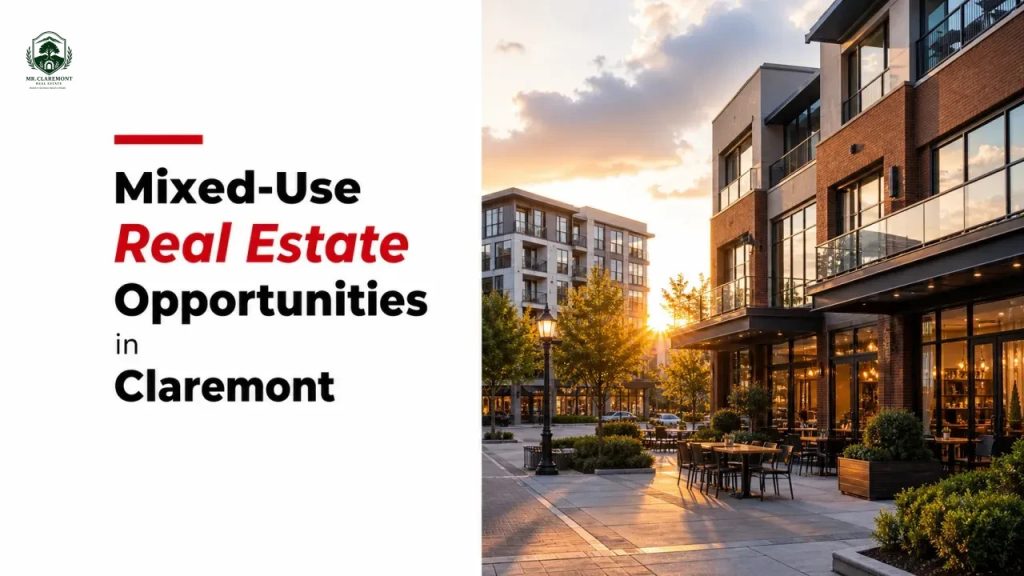
Mixed-use real estate opportunities in Claremont are strongest in and around the Village, transit-oriented corridors, and sites that can combine residential, retail, office, or service uses in a walkable setting. For buyers, investors, and owners, the appeal is simple: Claremont has real demand drivers, limited land, and a city framework that already supports carefully planned mixed-use growth.
Claremont isn’t a generic Inland Empire market. It has the Claremont Colleges, a well-known downtown, strong neighborhood identity, and a planning approach that favors thoughtful infill over random sprawl. That matters if you want to buy a home in Claremont, track home values in Claremont, or study where commercial and residential demand may overlap. From what we’ve seen, the best mixed-use plays here usually come down to location, zoning, parking, and whether a property fits the city’s long-term Village vision.
Why does Claremont have real mixed-use real estate potential?
Claremont has real mixed-use potential because the city already blends housing, retail, office, dining, and civic activity in a compact downtown environment. The local planning code and Village-area development policies don’t treat mixed-use as a fringe idea. They treat it as part of how Claremont grows without losing its character. (claremontca.gov)
The clearest signal is the City of Claremont’s Village South Specific Plan. The city says the plan is intended to guide “sustainable, mixed use, transit-oriented development” in the area south of the Village. That gives investors a pretty direct roadmap: Claremont is open to the right kind of mixed-use project in the right location. (claremontca.gov)
The zoning framework supports that idea too. Claremont’s MU Mixed Use District includes MU2, described as the College Avenue/South Village Transit-Oriented Mixed Use District, with design goals tied to the Village and alternative transportation. In the Claremont Village District, residential development can be permitted as one part of a larger mixed-use project. (ecode360.com)
A practical example: a building with ground-floor retail and upper-floor residential near the Village has a very different risk profile than a standalone commercial box farther from foot traffic. In Claremont, walkability and proximity matter a lot.
Where are the best areas for mixed-use real estate in Claremont?
The best areas for mixed-use real estate in Claremont are generally near the Village core, the Village South plan area, and corridors with strong visibility and access. In most cases, the closer a site is to downtown activity, Metrolink access, and college-driven foot traffic, the more compelling the mixed-use story becomes. (claremontca.gov)
Downtown Claremont is still the anchor. The Village already functions as the city’s urban core, with restaurants, shops, offices, entertainment, and nearby residential demand. The zoning language specifically says the Village District is meant to support retail, services, office functions, and residential uses that preserve and extend the downtown character. (ecode360.com)
Village South is the forward-looking zone to watch. The city created that planning framework to shape future mixed-use, transit-oriented development south of the Village. That makes it one of the most important submarkets for anyone looking at redevelopment, assemblage, or adaptive reuse potential. (claremontca.gov)
Here’s a quick area comparison:
| Area | Why it stands out | Best fit | Main caution |
|---|---|---|---|
| Claremont Village core | Existing walkability, dining, shops, office activity | Small mixed-use, retail + residential, office + residential | Limited inventory, higher entry costs |
| Village South | City-backed transit-oriented mixed-use planning | Redevelopment and longer-term value plays | Entitlement and design review matter |
| College-adjacent corridors | Steady student, faculty, and visitor activity | Service retail, flex office, housing over retail | Parking and tenant mix are critical |
| Edge commercial corridors | Better visibility and sometimes larger sites | Value-add repositioning | Less natural foot traffic |
What kinds of mixed-use properties make the most sense in Claremont?
The mixed-use properties that make the most sense in Claremont are usually smaller, walkable, and easy to understand: retail below with apartments or offices above, office-service combinations, or older commercial assets that can be repositioned. Big speculative projects can work, but Claremont often rewards fit and restraint more than sheer scale. (ecode360.com)
In a city like Claremont, tenant mix matters almost as much as zoning. A coffee shop, boutique retail space, professional office, wellness use, or neighborhood-serving restaurant can complement upstairs residential units well. That’s especially true near the Village, where people expect a human-scale environment rather than oversized freeway-oriented development.
Another path is adaptive reuse. Older buildings near downtown can sometimes be improved into a mixed-use format if the site, code, and economics line up. That won’t be right for every owner, but it can be appealing where the structure already has charm, frontage, and location.
Current listings also show that mixed-use inventory exists, though supply is limited. LoopNet has recently shown mixed-use and broader commercial-for-sale inventory in Claremont, which supports the view that opportunities are available but not abundant. (loopnet.com)
How does the Claremont housing market affect mixed-use opportunities?
The Claremont housing market supports mixed-use demand because residential supply is still relatively tight and buyer interest remains healthy. Realtor.com recently described Claremont as a seller’s market, with homes selling in a median of 37 days, which suggests ongoing demand for well-located housing near services and transit. (realtor.com)
That matters because successful mixed-use projects usually need one strong leg to support the whole property. In Claremont, residential can be that stabilizing piece. If an owner can pair housing demand with ground-floor commercial space in the right submarket, the property may benefit from diversified income rather than reliance on one tenant category.
And Claremont’s buyer profile helps. Between local professionals, faculty, students, downsizers, and residents who want a walkable lifestyle, there’s a real audience for living near downtown amenities. A mixed-use property that offers convenience can tap into that demand more directly than a conventional single-use site.
For anyone asking about the best time to buy in Claremont, the answer depends on the asset. Residentially anchored mixed-use can still make sense even in a competitive market if the location and entitlement story are strong.
What should investors check before buying a mixed-use property in Claremont?
Before buying a mixed-use property in Claremont, investors should check zoning, permitted uses, parking, tenant health, construction condition, and exit strategy. Mixed-use can look attractive on paper, but the details decide whether a deal is stable, expensive, or unexpectedly difficult to improve. (ecode360.com)
Here’s the short checklist:
- Confirm the zoning district and overlay rules.
- Verify whether residential use is allowed by right or by permit.
- Review parking ratios and access constraints.
- Study current rents, vacancy, and tenant lease terms.
- Inspect age, systems, and deferred maintenance.
- Ask about historic, design, or planning review limits.
- Model multiple exit paths: hold, refinance, reposition, or resale.
One common mistake? Buying based on a future idea rather than current legal reality. A seller may market a site as a mixed-use opportunity, but the city code, conditional use requirements, or design standards are what count.
Is mixed-use real estate in Claremont better for investors, owner-users, or local business owners?
Mixed-use real estate in Claremont can work for all three, but the best fit depends on goals. Investors often like diversified income. Owner-users may like controlling their operating location while adding rental revenue. Local business owners may like building equity in a place where location and brand visibility really count. (loopnet.com)
An investor might target a Village-area building with a storefront and upstairs apartments. An owner-user might buy a property with office space below and lease the second floor. A business owner could secure a long-term location and reduce exposure to rising commercial rents.
Claremont is especially interesting for owner-users because brand, visibility, and neighborhood feel carry weight here. If your customer base values local identity, being in the right part of Claremont can be a real business asset, not just a real estate decision.
How can you approach a mixed-use purchase in Claremont step by step?
The smartest way to approach a mixed-use purchase in Claremont is to start with location and zoning, then test income, risk, and future flexibility. Good deals here are rarely accidents. They’re usually the result of careful filtering before you spend money on inspections, consultants, or entitlement work. (claremontca.gov)
Use this process:
- Define your goal: investment yield, owner-user occupancy, redevelopment, or long-term hold.
- Narrow to Village, Village South, or another qualified corridor.
- Pull zoning and permitted-use data before touring seriously.
- Underwrite the property using current income, not hopeful future rent.
- Review physical condition and code issues early.
- Meet with local planning and land-use professionals if redevelopment is part of the plan.
- Compare the deal against simpler alternatives in Claremont, Upland, and nearby markets.
That last step matters. Sometimes the best mixed-use deal is the one you don’t force. But when the property has location, flexibility, and a clean path through city review, Claremont can be a very attractive market.
Should you consider mixed-use real estate if you also own a home in Claremont?
Yes, especially if you’re already watching home values in Claremont or thinking about broader wealth-building options. Mixed-use real estate isn’t just for large investors. In some cases, homeowners, local families, and business operators use it to add income, hedge against single-property risk, or build a longer-term foothold in the city’s core.
A homeowner planning to sell my home in Claremont might roll equity into a mixed-use asset with stronger income potential. Another owner might keep their house and buy a smaller commercial-residential building as a second investment. It depends on financing, risk tolerance, and time horizon.
If you want a local read on which streets, zoning pockets, and property types deserve a closer look, reach out to Mr. Claremont. A street-by-street review usually tells you more than a generic market headline ever will.