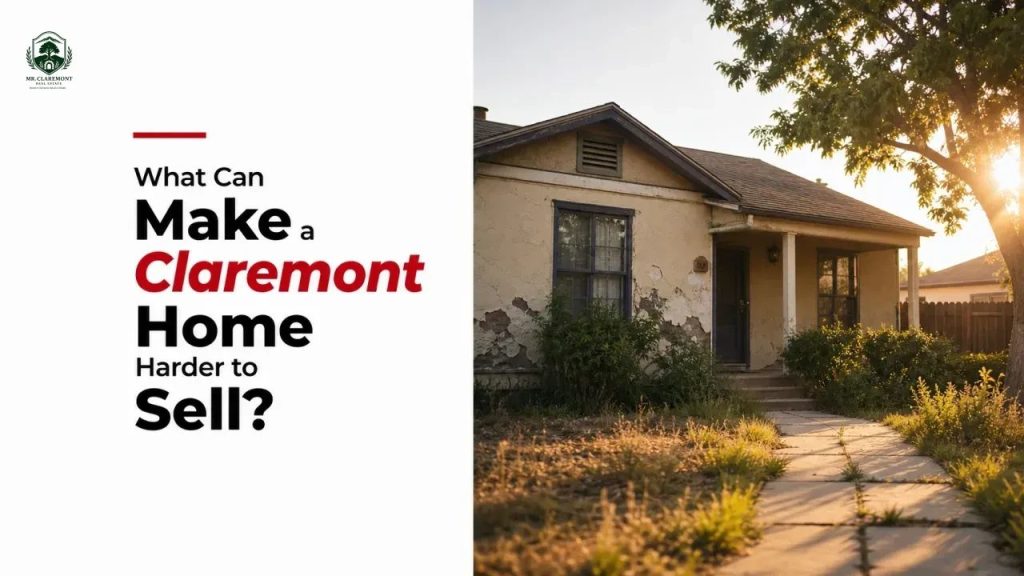
A Claremont home usually becomes harder to sell when price, presentation, condition, or location-specific buyer concerns don’t match the current market. In Claremont, that often means a home is priced above nearby competition, needs visible updates, or lacks the features buyers expect at roughly the $1 million price point. (redfin.com, realtor.com, zillow.com)
Claremont is not a distressed market. It’s a balanced one. As of August 2026, Realtor.com reports a median listing price around $1,016,500, median days on market of 43, and about 120 active listings. Redfin shows a median sale price of roughly $1,024,322 and average market time of 45 days. That tells you buyers are still active, but they’re taking longer to choose and comparing homes more carefully. (realtor.com, redfin.com)
Is overpricing the biggest reason a Claremont home sits?
Yes. Overpricing is usually the fastest way to make a Claremont home harder to sell because buyers in the Claremont housing market have enough inventory to compare value, condition, and location side by side. If your home misses the mark early, it can lose momentum fast. (realtor.com, redfin.com)
Buyers shopping in Claremont often cross-shop against Upland, La Verne, San Dimas, and parts of Rancho Cucamonga. If a home in 91711 is priced like a turnkey property near the Village or close to the Claremont Colleges, but it actually needs work, buyers notice right away. And once a listing lingers, people start wondering what’s wrong with it.
A seller who wants to sell my home in Claremont quickly usually needs to think in terms of buyer comparison, not seller aspiration. In most cases, the strongest pricing strategy is based on current competing listings, recent solds, and how your home shows online during the first week.
Can outdated condition turn buyers away in Claremont?
Absolutely. In Claremont, older homes can be a strength, but deferred maintenance is a problem. Buyers often love the character of neighborhoods like Old Claremont and areas near the Village, yet they still expect major systems, finishes, and curb appeal to feel cared for. (claremontca.gov, realtor.com)
That’s especially true in a city known for tree-lined streets, historic character, and distinctive architecture. The City of Claremont highlights the community’s historic Village, Claremont Colleges connection, and many single-family homes with architectural significance. When a house feels tired next to that backdrop, it stands out for the wrong reason. (claremontca.gov)
Common issues that slow sales include:
-
-
- Worn roofs or aging HVAC systems
- Dated kitchens and baths
- Old windows or poor insulation
- Flooring that photographs badly
- Landscaping that looks dry or neglected
- Paint colors that make rooms feel dark
Character helps. Neglect doesn’t.
Does location inside Claremont affect how fast a home sells?
Yes, and sometimes more than sellers expect. Even within Claremont, buyer demand shifts block by block depending on school preference, freeway access, neighborhood feel, and proximity to the Village, parks, or the colleges. (claremontca.gov, cusd.claremont.edu)
Claremont Unified School District includes seven elementary schools, one middle school, and two high schools, including Claremont High School. Families often pay close attention to school-adjacent areas and neighborhood reputation. Schools like Sycamore Elementary and Claremont High School are part of how many buyers frame their search. (cusd.claremont.edu, sycamore.cusd.claremont.edu)
Location challenges that can narrow your buyer pool include:
-
-
- Backing to busy roads like Foothill Boulevard or Indian Hill Boulevard
- Being too close to the 210 Freeway
- Limited parking near denser areas
- Steep hillside or odd-lot layouts in some northern sections
- Less walkability compared with homes near the Village
That doesn’t mean the home won’t sell. It means the price and marketing need to account for it.
What listing features do Claremont buyers expect at this price point?
At around Claremont’s current price level, buyers expect more than square footage. They want a home that feels move-in ready, well-photographed, and easy to understand online before they ever schedule a showing. (realtor.com, redfin.com, zillow.com)
In plain English, a million-dollar listing that looks messy, dark, or confusing online is going to struggle.
Here’s a simple comparison:
| Feature |
Helps a Home Sell Faster |
Can Make It Harder to Sell |
| Pricing |
Aligned with recent comps and condition |
Priced as if fully renovated when it isn’t |
| Photos |
Bright, clean, professional images |
Dim photos, missing rooms, poor angles |
| Condition |
Fresh paint, clean systems, minor repairs done |
Deferred maintenance, obvious wear |
| Layout presentation |
Clear use of each room |
Awkward spaces left unexplained |
| Outdoor space |
Tidy landscaping, usable backyard |
Overgrown yard or high-maintenance exterior |
| Location framing |
Honest positioning with strengths highlighted |
Weak listing copy that ignores objections |
This matters a lot for homes for sale in Claremont because buyers often begin with online comparison shopping. If the listing doesn’t answer obvious questions, they move on.
Can poor marketing make even a good Claremont home harder to sell?
Yes. A solid home can still sit if the listing launch is weak. Bad photos, vague description writing, missing floor plan details, or a lack of neighborhood context can all reduce showings and buyer confidence.
Claremont is not a generic suburb. Buyers want context. They want to know whether a home is near the Village, close to Thompson Creek Trail, convenient to the Claremont Colleges, or tucked into a quieter residential pocket. The City notes that Claremont has 21 city-owned parks and sports fields plus the 2.8-mile Thompson Creek Trail, and those lifestyle details can influence demand. (claremontca.gov)
Good marketing also means telling the truth clearly. If the home has a smaller lot, no primary-suite update, or a busier street location, the listing should frame the tradeoff honestly rather than dodge it. Buyers usually reward clarity.
Are inspection issues and disclosure surprises a major deal killer?
They can be. Inspection trouble rarely helps a sale, but surprise is what really kills momentum. Buyers can handle an older sewer line, dated electrical panel, or roof nearing end of life if the home is priced accordingly and the information comes out early.
In Claremont, many homes have age and character. That can mean real maintenance questions. If a seller waits for the buyer’s inspector to uncover obvious issues, negotiations often get harder and escrow becomes shakier. This is one reason pre-listing prep matters so much when thinking about home values in Claremont.
A smoother path usually looks like this:
-
-
- Get a realistic pricing opinion.
- Handle easy repairs before listing.
- Gather records for roof, HVAC, plumbing, and upgrades.
- Consider pre-listing inspections for older homes.
- Disclose known issues early and clearly.
- Price with those facts in mind.
That sequence won’t remove every objection, but it usually reduces last-minute renegotiation.
Does buyer timing matter in Claremont?
Yes, though not as much as price and condition. Timing can affect how many active buyers are watching, how much competition you face, and how patient buyers feel. In a market where homes average about 43 to 45 days on market, timing mistakes can make an already borderline listing feel stale. (realtor.com, redfin.com)
For example, launching when several similar homes hit the market at once can make yours blend in. Listing before basic landscaping, paint touch-ups, or cleaning are done can also waste your strongest exposure window. First impressions matter more than many sellers think.
If you’re planning to sell your house fast in Claremont, the best time is usually when the home is fully ready, not just when the calendar says go. That sounds simple, but it saves a lot of regret.
What should a Claremont seller do before listing?
Start with honest positioning. A Claremont seller should look at the home the way a buyer will: compared with nearby listings, judged by photos first, then by condition, then by price. The goal is not to chase the highest fantasy number. It’s to create the best actual sale.
A practical pre-listing checklist:
-
- Walk the home like a first-time buyer.
- Fix visible cosmetic problems.
- Declutter and improve natural light.
- Review recent Claremont comps and active competition.
- Decide whether your home is turnkey, average, or project-level.
- Price according to that category.
- Launch with strong photos and clear local marketing.
If you want a clear opinion on what is my home worth in Claremont, or what may be holding your sale back, a local pricing and prep strategy is usually the best first step. And if you’d like help sorting that out, reach out to
Mr. Claremont.
FAQs
Can a Claremont home sit on the market even in a good market?
Yes. A good market does not guarantee a quick sale if the home is overpriced, poorly presented, or has location or condition drawbacks. Buyers in Claremont still compare options carefully and often skip listings that feel like a reach on value. In a balanced market, homes still sell, but not all at the same speed. Properties that launch cleanly and competitively tend to do better than listings that need price cuts after sitting.
Do older Claremont homes sell slower?
Not necessarily. Older Claremont homes can sell well when their character is matched by solid upkeep, smart pricing, and clear disclosures. Age alone is not the problem; deferred maintenance and surprise repair issues are what usually slow buyer interest. Many buyers actually want charm and established neighborhoods. They just don’t want to inherit a long repair list without the price reflecting it.
How much does school location matter in Claremont?
School location matters quite a bit for many buyers, especially families targeting Claremont Unified areas. A home near sought-after schools or in a well-known neighborhood often gets stronger attention than a similar home in a less preferred pocket. That doesn’t mean other homes won’t sell. It means pricing and marketing need to reflect the specific buyer pool more accurately.
Will staging and photography really make a difference?
Yes. Strong staging, decluttering, and professional photography can improve first impressions, online click-through, and showing activity. In Claremont’s price range, buyers expect listings to feel polished before they ever step through the front door. Even small changes can help, especially better lighting, cleaner surfaces, fresh paint, and more useful room presentation.
What is the biggest mistake sellers make in Claremont?
The biggest mistake is usually overpricing at launch. Sellers sometimes assume buyers will negotiate down, but an inflated list price often reduces showings, weakens momentum, and leads to a lower final result after price cuts. Early interest is valuable. Once that window fades, the home often becomes harder to reposition.