

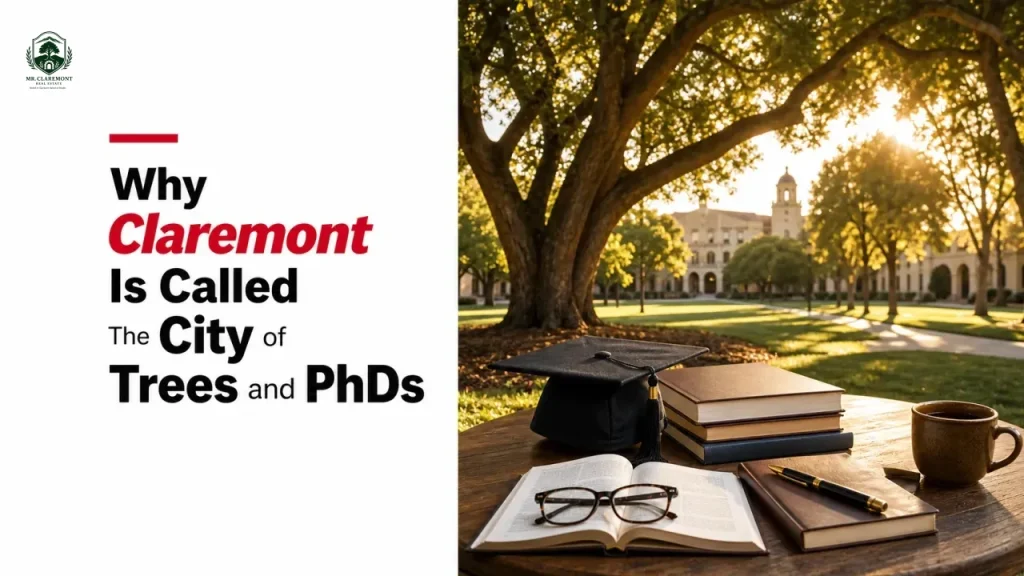
Claremont is called the City of Trees and PhDs because two things shape daily life here more than almost anything else: a remarkably dense urban forest and one of the most distinctive college clusters in the country. The nickname fits the city’s look, culture, and housing demand in a way that feels real the moment you drive down its shaded streets. (claremont.edu)
For anyone thinking about moving to Claremont, buying a home, or tracking home values in Claremont, that nickname is more than local branding. It helps explain why Claremont feels different from many other Inland Empire and eastern Los Angeles County communities: it’s greener, more academic, more walkable in key areas, and unusually protective of neighborhood character. (claremontca.gov)
Why is Claremont called the City of Trees and PhDs?
Claremont gets the nickname from the pairing of its tree-filled streets and its concentration of higher education. The “trees” part reflects a long civic commitment to its urban forest, while the “PhDs” part points to the Claremont Colleges and the city’s deeply academic identity. (claremont.edu)
You can see the “trees” piece in official city materials. The City of Claremont reports 24,108 city trees and notes it has been recognized as a Tree City USA winner for over 30 years. That’s not a throwaway slogan. It reflects a place where the canopy is visible, managed, and part of local identity. (claremontca.gov)
The “PhDs” side is just as grounded in reality. The Claremont Colleges consist of five undergraduate colleges and two graduate institutions: Pomona College, Claremont Graduate University, Scripps College, Claremont McKenna College, Harvey Mudd College, Pitzer College, and Keck Graduate Institute. In a city of roughly 35,000 people, that academic footprint is huge. (claremont.edu)
And that combination matters for real estate. Buyers looking at homes for sale in Claremont often notice the atmosphere first: mature trees, preserved neighborhoods, and a college-town feel that’s rare in Southern California. That blend tends to support long-term buyer demand. (claremontca.gov)
How did trees become such a big part of Claremont’s identity?
Trees became central to Claremont’s identity because they were planted early, protected over time, and woven into how the city presents itself. This isn’t accidental landscaping. It’s a long-running civic project that helped shape how neighborhoods look and how residents think about place. (claremontca.gov)
The city’s own history and tree pages point to decades of stewardship. Claremont’s official seal even features an avocado tree, which tells you how old and symbolic this connection is. City materials also describe how early community builders planted and cared for young trees as the town grew. (claremontca.gov)
That history still shows up block by block. Streets in established neighborhoods near the Village, the colleges, and the foothill areas often feel cooler, quieter, and more established because of mature canopy cover. For someone planning to buy a home in Claremont, that can affect everything from curb appeal to walkability to how a street “feels” at 5 p.m. in August.
Claremont also continues to actively manage its urban forest through planning and maintenance. Official city resources reference an Urban Forest Program and an Urban Forest Management Plan, which signals that the tree identity is still being maintained rather than simply inherited. (claremontca.gov)
Why do the Claremont Colleges matter so much to the city’s identity?
The Claremont Colleges matter because they give Claremont an intellectual and cultural presence far larger than its population suggests. They shape architecture, events, dining, walkability, and even the buyer pool, which is a big reason Claremont feels distinct from nearby cities like Upland, Pomona, and Rancho Cucamonga. (claremont.edu)
This is not a one-campus town. It’s a seven-school consortium with national reach. That brings professors, graduate students, staff, visiting scholars, and families into the market on a recurring basis. Even buyers who have no direct college connection often want the lifestyle that grows around that environment: bookstores, older homes, cultural programming, and a walkable downtown core.
A simple example: a buyer comparing Claremont with another nearby market may find similar square footage elsewhere, but not the same mix of shaded streets, historic homes, college architecture, and easy access to the Village. That’s where the “PhDs” part becomes a real housing story, not just a clever nickname.
For sellers, this identity can help with positioning. If you want to sell my home in Claremont searches to convert, the listing story usually works better when it explains the lifestyle clearly: college-town energy, tree-lined streets, and a location with foothill access plus rail and freeway connections.
What does the nickname tell you about Claremont neighborhoods and lifestyle?
The nickname tells you Claremont is likely to appeal to buyers who care about character, shade, walkability, schools, and a more thoughtful pace of life. In practice, “Trees and PhDs” points to a market where setting and identity often matter almost as much as square footage. (claremontca.gov)
You feel it in the Village, near the colleges, and in many established residential pockets. Tree-lined streets soften the city visually, while the academic presence supports coffee shops, events, lectures, and a steady stream of local activity. That’s a big reason Claremont gets attention from both local move-up buyers and out-of-area buyers relocating for work or school connections.
Here’s a simple lifestyle comparison:
| Claremont trait | What it means day to day | Why buyers care |
|---|---|---|
| Mature tree canopy | More shade, stronger curb appeal, established feel | Streets feel more livable and visually calm |
| Seven-college presence | Lectures, arts, research, student energy | Strong college-town identity |
| Village-centered layout | Walkable dining and shopping in key areas | Lifestyle appeal beyond the house itself |
| Historic character | Older homes and preserved streetscapes | Distinctive housing stock |
| Foothill setting | Access to trails and mountain views | Outdoor appeal with suburban convenience |
For many households, that mix answers the question of whether Claremont is just a place to live or a place with a clear sense of identity. Usually, it’s the second one.
How does the City of Trees and PhDs reputation affect the Claremont housing market?
The reputation helps Claremont hold a premium image because buyers aren’t only purchasing a house; they’re buying into a place with a strong brand and a proven lifestyle. That doesn’t make the market immune to shifts, but it does help explain why demand often stays resilient. (realtor.com)
As of August 2026, Realtor.com shows a median listing price of about $1 million in Claremont and an average of 43 days on market. Redfin similarly reports a median sale price around $1.0 million over the three months ending July 2026, while Zillow reports an average home value of $1,037,849, up 2.3% year over year, with homes going pending in about 25 days. (realtor.com)
Those figures won’t tell you everything about your block or price point, of course. But they do support the broader idea that Claremont remains a desirable market. Neighborhood identity, school reputation, and the city’s physical setting all feed into that.
For buyers asking should I buy or rent in Claremont, the answer often comes down to timeline. If you expect to stay several years and you value the specific Claremont lifestyle, ownership can make more sense than trying to chase limited housing options in a market with consistent demand.
What should buyers and sellers pay attention to in Claremont right now?
Buyers and sellers should pay attention to micro-location, canopy-rich streets, school-adjacent demand, and pricing realism. In Claremont, broad market averages help, but the real story often sits at the neighborhood and even block level, especially near the Village and college-influenced areas. (realtor.com)
If you’re buying, focus on these steps:
- Decide whether you want Village walkability, foothill views, or a quieter interior tract feel.
- Compare tree coverage and street character, not just bed-bath counts.
- Review current pricing against recent comparable sales, not last year’s peak assumptions.
- Check commute routes to nearby job centers, Metrolink access, and freeway connections.
- Move quickly on well-located homes that combine condition, shade, and neighborhood appeal.
If you’re selling, remember that Claremont buyers respond strongly to presentation. Mature landscaping, outdoor spaces, and a clear “why this location matters” message can make a real difference. In a city like this, the story around the home matters almost as much as the finishes inside.
Is Claremont’s nickname actually useful when deciding where to live?
Yes, the nickname is useful because it captures the traits that most clearly shape daily life in Claremont: greenery, education, character, and community identity. It’s a shorthand, but it’s an unusually accurate one for people deciding whether Claremont fits their priorities. (claremont.edu)
Some nicknames are marketing fluff. This one is closer to a buyer filter. If you want a newer, more purely suburban environment, another nearby city may fit better. But if you want mature streets, a true college-town atmosphere, and a place with a strong local identity, Claremont stands out.
That’s also why the phrase keeps showing up in official, institutional, and local descriptions of the city. It works because it’s observable. Spend one afternoon near the colleges and the Village, then drive the residential streets north of Foothill Boulevard, and the nickname explains itself. (claremont.edu)
If you’re weighing a move, buying your first home, or trying to figure out what is my home worth in Claremont, local context matters. And in Claremont, context starts with the trees and the colleges. For tailored advice on neighborhoods, timing, and value, reach out to Mr. Claremont.