

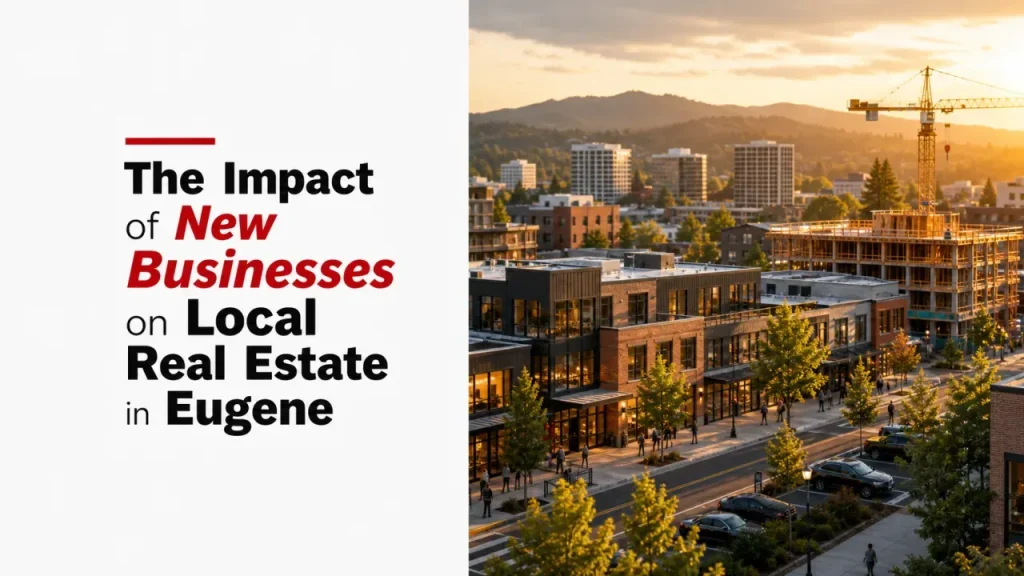
New businesses can raise real estate demand in Eugene by adding jobs, increasing neighborhood activity, and making certain areas more appealing to buyers and investors. In most cases, the effect shows up first in demand near employment centers, downtown corridors, and mixed-use districts, then spreads into nearby neighborhoods as more people look to buy or rent. (eugene-or.gov)
Eugene’s housing market is already competitive. Redfin reports a median sale price of about $500,000, homes selling in roughly 21 days, and an average of three offers per listing over the three months ending May 2026. That means even modest business growth can matter because new demand enters a market that is not sitting still. (redfin.com)
How do new businesses affect Eugene home values?
New businesses tend to support home values in Eugene because they bring jobs, wages, and daily foot traffic that make nearby neighborhoods feel more convenient and stable. The biggest gains usually happen where business growth is paired with housing, transportation, and visible street-level improvements rather than one isolated project. (eugene-or.gov)
Here’s the plain-English version: when employers expand or new commercial activity arrives, more people want to live within an easy drive, bike ride, or bus trip of work. In Eugene, that often means more attention on downtown-adjacent areas, corridors near major services, and neighborhoods with quick access to the University of Oregon, transit, and established retail.
A good local example is the City-backed 1059 Willamette project downtown. The city says the six-story mixed-use, mixed-income development will add 133 apartments and more street activity to a key downtown block. Projects like that don’t just add housing. They also strengthen the case for nearby restaurants, shops, and service businesses, which can make surrounding real estate more attractive. (eugene-or.gov)
Which parts of Eugene are most likely to feel the impact first?
The areas most likely to feel the impact first are downtown Eugene, nearby central neighborhoods, and places connected to future employment and infrastructure investment. Buyers usually respond fastest where they can see change happening on the ground, not just in long-range planning documents. (eugene-or.gov)
Downtown stands out because Eugene is actively tying housing and economic activity together. The city’s economic development program supports business growth, façade improvements, downtown lending, and other tools meant to add vitality. That kind of policy support can make a district more desirable over time because businesses and residents reinforce each other. (eugene-or.gov)
Another area to watch is the Clear Lake industrial area and other employment-focused land. City materials say state support for the Clear Lake infrastructure project is intended to bring economic development opportunities, and separate city testimony tied regional jobs planning to the possibility of thousands of jobs. Not every proposed job appears overnight, of course, but employment land investment often shapes where future housing demand concentrates. (eugene-or.gov)
What does Eugene’s housing market look like right now?
Eugene’s housing market appears balanced to competitive, depending on which metric you watch. Prices are still edging up, homes are moving fairly quickly, and inventory is not especially loose, which means business growth has a decent chance of putting extra upward pressure on well-located homes. (redfin.com)
Here’s a simple market-at-a-glance view using recent public data:
| Metric | This period | Trend |
|---|---|---|
| Median sale price | About $500,000 | Up 0.9% year over year (redfin.com) |
| Average days on market | About 21 days | Slightly slower than last year’s 19 days (redfin.com) |
| Homes sold | 449 in May 2026 | Up from 441 a year earlier (redfin.com) |
| For-sale inventory | 547 listings on June 30, 2026 | Active supply available, but not oversupplied (zillow.com) |
| Median listing price | $538,800 | Suggests sellers still see pricing support (zillow.com) |
One thing I’d stress for anyone moving to Eugene: business growth does not affect every block equally. A new employer, retail node, or mixed-use project can noticeably change demand in one pocket of town while leaving another area mostly steady for months.
Why do mixed-use and downtown projects matter so much?
Mixed-use and downtown projects matter because they change how people live day to day. A neighborhood with housing, coffee shops, services, transit access, and walkable streets tends to attract more buyers than a place that only adds one building and nothing else around it. (eugene-or.gov)
That is part of why the 1059 Willamette project is worth watching. The city describes it as a mixed-use, mixed-income development meant to add homes and street activity in the core. More residents downtown can support more businesses; more businesses can make downtown living more appealing. That feedback loop is often where local real estate momentum starts. (eugene-or.gov)
Eugene is also updating land-use rules through its Urban Growth Strategies work. In June 2026, the city advanced code changes aimed at expanding housing and job opportunities, including updates for middle housing and building height in some areas. Those policy moves matter because they can make it easier to add the homes needed when business growth increases demand. (eugene-or.gov)
What does this mean for buyers in Eugene?
For buyers, new business growth usually means acting early in areas that are improving before price jumps become obvious to everyone. If you want to buy a home in Eugene, pay close attention to neighborhoods near downtown improvements, transit, and employment corridors rather than looking only at today’s price tag. (eugene-or.gov)
A practical example: two homes may be priced similarly today, but the one closer to an improving commercial district, a redevelopment zone, or an expanding job center may hold value better over the next few years. Buyers who think this way often care less about the cheapest house and more about the strongest location story.
That said, don’t assume every new business guarantees appreciation. A small retail opening is not the same as a major employment anchor, a city-backed downtown housing project, or an infrastructure investment that unlocks larger commercial growth. Local context matters a lot.
What does this mean for sellers in Eugene?
For sellers, new businesses can strengthen your pricing story if your home is near the right kind of growth. If you’re planning to sell your home in Eugene, proximity to job centers, downtown amenities, and active redevelopment can become part of the value conversation when paired with solid comps. (redfin.com)
Sellers should be careful, though. Buyers still look at condition, layout, and monthly payment first. Being “near future growth” helps most when the change is visible and credible. A home near a district with new apartments, storefront upgrades, and improved street activity usually tells a clearer story than a home near a project that is still mostly conceptual.
And timing matters. In a market where homes are already moving in about three weeks on average, sellers who list with strong presentation and realistic pricing can still benefit from that underlying demand. (redfin.com)
Is Eugene likely to see more real estate pressure as business growth continues?
Yes, Eugene is likely to see ongoing real estate pressure if business development and housing growth continue together. The city is openly planning for more housing and employment capacity, and public documents show Eugene expects significant long-term housing demand, which suggests future competition for well-located homes may persist. (eugene-or.gov)
The city has cited the 2025 Oregon Housing Needs Analysis saying Eugene needs more than 26,000 new dwelling units over the next 20 years. That doesn’t mean prices only go one way, but it does mean the region expects meaningful demand. Add job creation efforts, downtown reinvestment, and industrial-area planning, and the big picture points to continued pressure on desirable neighborhoods. (eugene-or.gov)
If you’re weighing whether now is a good time to buy in Eugene or when to list, keep your eye on two things: where jobs are clustering and where the city is making it easier to add housing. Usually, the strongest local real estate stories sit where those two lines cross.
Is Eugene a buyer’s or seller’s market right now? Based on recent public data, Eugene looks balanced to slightly seller-friendly rather than heavily tilted either way. Homes are selling in about 21 days, median sale prices are still up year over year, and sale-to-list ratios are near 100%, which points to steady demand. (redfin.com)
Are home prices going up in Eugene? Yes, though not at a runaway pace. Redfin reports Eugene home prices were up 0.9% year over year over the three months ending May 2026, which suggests gradual appreciation instead of a dramatic spike. (redfin.com)
Do new businesses always increase nearby home values? No. New businesses can support demand, but the effect depends on the type of business, job quality, visibility of the investment, and whether the area also gains housing, transit access, and neighborhood improvements. Local real estate rarely moves for one reason alone.
Is downtown Eugene a good area to watch for real estate change? Yes. Downtown Eugene is a logical area to watch because the city is supporting mixed-use housing, economic activity, and redevelopment projects like 1059 Willamette, which can increase neighborhood appeal over time. (eugene-or.gov)
Should buyers focus on current price or future growth potential? Both matter, but future growth potential can be the tie-breaker. In many cases, a well-located home near credible employment and redevelopment activity performs better over time than a similar home in a less connected area.
If you want help reading Eugene’s neighborhood-by-neighborhood trends, a local expert can help you sort hype from real value. The smartest move is usually to look at employment growth, housing supply, and block-level livability together.